
Quadrupole Depth Profiler: SIMS 4550
The CAMECA SIMS 4550 is a flexible, quadrupole-based dynamic Secondary Ion Mass Spectrometer built around CAMECA's unique FLIG (Floating Low-energy Ion Gun) technology for oxygen and cesium primary beams.
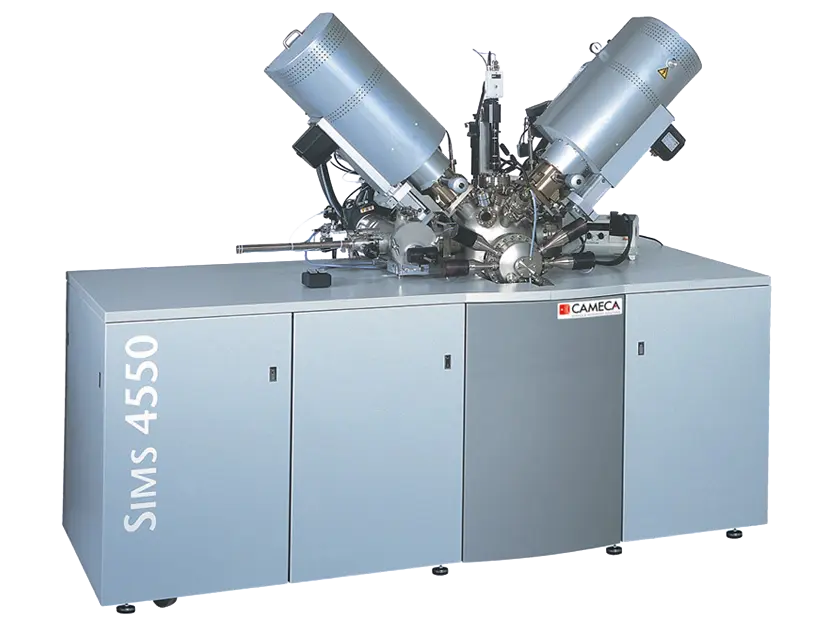
Manufacturer: CAMECA — France
Overview
The CAMECA SIMS 4550 is a flexible, quadrupole-based dynamic Secondary Ion Mass Spectrometer built around CAMECA's unique FLIG (Floating Low-energy Ion Gun) technology for oxygen and cesium primary beams. It delivers benchmark depth resolution and sensitivity for ultra-shallow implant, trace element, and thin-layer composition measurements in silicon, high-k dielectrics, SiGe, and III-V compound materials. Impact energy is programmable from 5 keV down to less than 150 eV, and the sputter angle is freely adjustable from normal to glancing incidence for both cesium and oxygen primary ions. Designed for ease of use, the SIMS 4550 lets process engineers with varied levels of SIMS expertise obtain accurate depth profiles, elemental composition, and segregation data for process diagnostics, R&D, and production yield control. Automated multi-analysis queuing, batch processing, and remote operation make it well suited for routine in-house monitoring of implants, epitaxial layers, and oxynitride films.
Measurement Principle
The SIMS 4550 is a quadrupole dynamic SIMS instrument that combines a high-current, high-quality FLIG primary ion gun with a quadrupole mass analyzer offering high transmission for both heavy and light elements. The free sputter angle capability, from normal to glancing incidence, allows optimal analytical conditions to be selected independently of primary ion energy or species. This flexibility lets the instrument address conventional and ultra-shallow implants, oxynitrides, low- and high-k dielectrics, compound semiconductors, and coatings on glass or steel.
Depth Profiling Performance & Depth Resolution
With ultra-low primary beam energy down to 150 eV, the SIMS 4550 resolves oxynitride layers with depth resolution better than 1 nm/decade and quantifies strained SiGe test pads with a depth resolution of 1.5 nm/decade at normal incidence. Shallow arsenic implant profiles combine a high erosion rate above 100 nm/min with a dynamic range spanning 6 orders of magnitude within a single depth profile. Epitaxial layer measurements, such as Al in GaAs, resolve atomic layers across five orders of magnitude with a decay length of 0.7 nm at 600 nm depth.
Automation & Ease of Use
Automated multi-analysis queuing, unattended diagnostic routines, and pre-programmed recipes let operators of varied experience levels set up and run repeatable measurements quickly. Batch processing supports unattended overnight measurement campaigns, while remote operation and e-diagnostics allow off-site monitoring and troubleshooting. All instrument settings from each measurement are stored in a database, so repeated measurements are only a few mouse clicks away.
Primary Ion Sources
CAMECA's FLIG (Floating Low-energy Ion Gun) technology supplies high-current, high-quality oxygen and cesium primary ion beams across the entire energy range, supporting fast, small-area depth profiling of conventional and ultra-shallow implants. Optical Conductivity Enhancement (OCE) provides reliable charge compensation for quantification in SiGe and other amorphous silicon matrices. Ultra stable ion sources and electronics support precision and repeatability down to less than 0.2% RSD.
Detection
The SIMS 4550's quadrupole analyzer optics and superior peak-to-background performance deliver low detection limits for trace elements, including excellent sensitivity for H, C, N, and O. Dose measurement precision is within 1% for boron and arsenic, with beam current stability held within 1%. The main analytical chamber operates in the low E-10 mbar range, an advanced UHV design that underpins the instrument's low detection limits even in insulating materials.
Applications
The SIMS 4550 covers implant analysis, SiGe technology development, and multilayer analysis on insulators such as reflector coatings, combining high sensitivity with high depth resolution. It is qualified for any application requiring elemental analysis at ultra-high depth resolution, from semiconductor process diagnostics to broader materials science and insulator analysis. Checkerboard gating enables depth profiling on small test pads by letting operators select the area of interest off-line after an automated measurement.
Software
Fast mass spectrum acquisition and 4D depth profiling capture more than 50 images (mass channels) per second, giving operators rich data sets for post-processing. Checkerboard gating allows ion images to be recorded on every beam scan for each detected element, so the electronic gate can be modified after measurement to remove artifacts from sample inhomogeneity or dust without re-running the analysis. WinCurve provides high-volume SIMS data acquisition and processing capabilities, covering both depth profiling and mass spectra.
Common Specifications
| Specification | SIMS 4550 |
|---|---|
| Primary ion sources | Cs⁺ and O2⁺ (FLIG – Floating Low-energy Ion Gun) |
| Impact energy range | < 150 eV to 5 keV |
| Sputter angle | Free, from normal to glancing incidence |
| Depth resolution | < 1 nm/decade (oxynitrides, 250 eV O2 @ 70°) |
| Depth resolution (SiGe) | 1.5 nm/decade (250 eV O2 @ 0°) |
| Erosion rate | > 100 nm/min |
| Dynamic range | Up to 6 orders of magnitude in a single profile |
| Dose measurement precision | Within 1% for B and As |
| Beam current stability | Within 1% |
| Repeatability | < 0.2% RSD |
| Analytical chamber vacuum | Low E-10 mbar range |
| Sample size | A few mm² up to 100 mm diameter |
| Mass spectrometer | Quadrupole analyzer |
| Imaging speed | > 50 images (mass channels) per second |