
High-Resolution Nanoanalysis SIMS: NanoSIMS-HR & Cryo
The NanoSIMS-HR is the next-generation secondary ion mass spectrometer in CAMECA's world-renowned NanoSIMS 50/50L series, engineered to push nanoscale chemical and isotopic imaging to new limits.
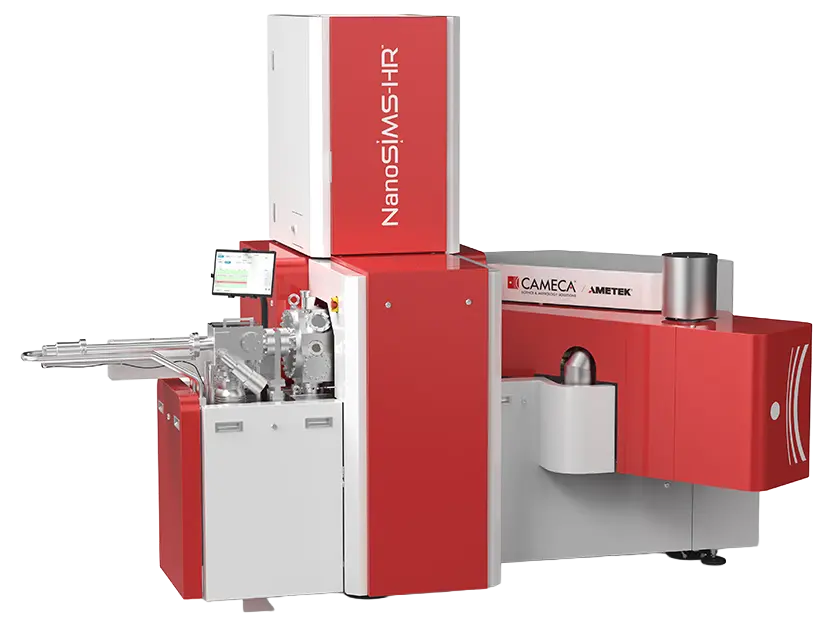
Manufacturer: CAMECA — France
Overview
The NanoSIMS-HR is the next-generation secondary ion mass spectrometer in CAMECA's world-renowned NanoSIMS 50/50L series, engineered to push nanoscale chemical and isotopic imaging to new limits. It achieves an unprecedented lateral resolution of ≤ 30 nm with a cesium primary ion source and ≤ 50 nm with an oxygen source, enabling sharper imaging and more accurate isotopic measurements by minimizing lateral beam dilution. A redesigned, higher-brightness cesium source and RF-plasma oxygen source, combined with an optimized vacuum system and anti-vibration isolation platform, deliver up to 2.5 times faster image acquisition alongside improved reliability and uptime. Automated sample exchange, a novel high-precision sample stage and a large choice of sample holders enable up to ten times faster unattended chained analysis for high-throughput, remote operation. Optional glovebox and cryogenic accessories extend the instrument to atmospheric-sensitive and frozen-hydrated biological and volatile-rich samples, opening new possibilities in cell biology, geoscience and materials research.
Measurement Principle
The NanoSIMS-HR is a secondary ion mass spectrometer that focuses a cesium or oxygen primary ion beam onto the sample surface to sputter and ionize atoms for mass analysis. Secondary ions generated from the sputtered volume are separated according to mass and simultaneously collected, producing quantitative chemical and isotopic images at the nanoscale. This continuous, DC-mode operation preserves high sensitivity independent of the imaged spot size.
Unprecedented Lateral and Depth Resolution
The instrument achieves a lateral resolution of ≤ 30 nm with the cesium source and ≤ 50 nm with the oxygen source, a marked improvement over the earlier NanoSIMS 50L's 50 nm resolution. This finer beam minimizes lateral beam dilution, improving the accuracy of isotopic measurements from small regions of interest. Depth resolution reaches ≤ 12 nm per decade at 4 keV impact energy, enabling superior profiling of multilayer structures such as boron-doped semiconductor stacks.
Redesigned Ion Sources
A new, brighter cesium ion source with higher current density enables 2.5 times faster image acquisition at 100 nm lateral resolution without any loss of resolution. A redesigned RF-plasma oxygen source with an upgraded cooling system improves robustness and uptime. Together with an optimized vacuum system built on the latest Pfeiffer turbomolecular and primary pumps, these sources reduce cost of ownership while sustaining high beam stability.
Multicollection and Detection
Up to seven masses, spanning the periodic table from hydrogen to plutonium, can be recorded simultaneously from the same sputtered micro-volume. Detection limits reach ≤ 2×10¹⁴ P atoms/cm³ in silicon within a 12 µm² analysis area, and isotopic reproducibility of ≤ ± 1.65‰ (1σ) has been demonstrated for δ30Si across a full sample holder. New high-resolution electronics facilitate peak centering and tuning optimization for consistently accurate multicollector data.
Automated Sample Handling and Throughput
Push-button sample exchange completes within five minutes, and a novel sample stage design delivers accuracy of ≤ 0.5 µm for up to ten times faster unattended, chained analysis of multiple samples. A 3.6 x 4 mm² optical image mosaic enables accurate navigation to regions of interest within 500 nm, while remote operation supports large, multi-holder analysis sessions with minimal operator intervention. A choice of large sample holders accommodates samples of various sizes for higher-throughput laboratories.
Cryogenic and Glovebox Accessories
An optional cryogenic stage cools samples down to -140 °C, enabling analysis of frozen-hydrated biological and volatile-rich specimens without loss of structural or chemical integrity. A companion glovebox, maintaining humidity at or below 10 ppm, protects atmosphere-sensitive samples during preparation and loading. This cryo capability has been used to reveal sub-micron chemical heterogeneity inside complex, multi-phase fluid inclusions and to preserve delicate biological ultrastructure for isotopic imaging.
Applications
The NanoSIMS-HR extends the legacy of the NanoSIMS 50/50L series across materials science and semiconductors, geo- and cosmochemistry, plant and soil sciences, environmental microbiology, cell biology and medical research. Its combination of high spatial resolution and high sensitivity supports applications ranging from 3D nanowire reconstruction to accurate isotopic mapping of labeled compounds inside individual cells. The instrument is designed to accelerate discovery under increasing sample throughput demands and tighter research deadlines.
Common Specifications
| Specification | NanoSIMS-HR & Cryo |
|---|---|
| Lateral resolution (cesium source) | ≤ 30 nm |
| Lateral resolution (oxygen source) | ≤ 50 nm |
| Depth resolution | ≤ 12 nm/decade @ 4 keV impact energy |
| Multiplex imaging | Up to 7 masses, from H to Pu |
| Detection limit | ≤ 2×10¹⁴ P atom/cm³ in Si within 12 µm² |
| Sample exchange time | Within 5 minutes (push-button) |
| Sample stage accuracy | ≤ 0.5 µm |
| Reproducibility | ≤ ± 1.65‰ (1σ) δ30Si in full holder |
| Cryo stage temperature (accessory) | Down to -140 °C |
| Glovebox humidity (accessory) | ≤ 10 ppm |
| Optical navigation image area | 3.6 × 4 mm² |
| Navigation accuracy | Within 500 nm |
| Imaging speed improvement | 2.5× faster at 100 nm lateral resolution (cesium source) |
| Chained-analysis throughput improvement | Up to 10× faster unattended acquisition |
| Footprint | L 6.80 m / W 5.20 m / H 2.85 m |