SIMS for Materials & Geosciences: NanoSIMS 50L
The NanoSIMS 50L is CAMECA's high-resolution secondary ion mass spectrometer purpose-built for imaging and quantifying trace elements and isotopes at the sub-micron scale.
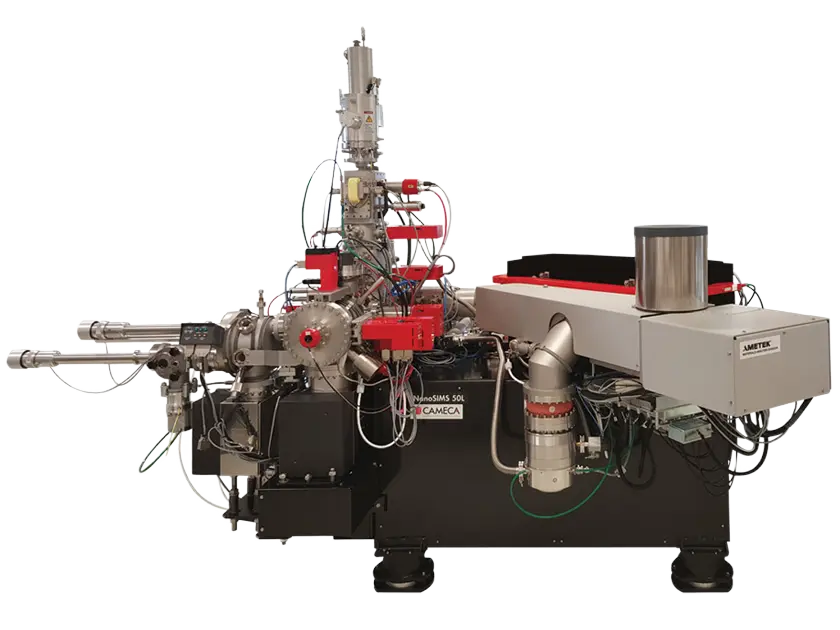
Manufacturer: CAMECA — France
Overview
The NanoSIMS 50L is CAMECA's high-resolution secondary ion mass spectrometer purpose-built for imaging and quantifying trace elements and isotopes at the sub-micron scale. Based on an original co-axial design by Professor Georges Slodzian at the University of Paris Sud, it focuses and rasters a cesium or oxygen primary ion beam onto the sample surface at normal incidence and analyzes the sputtered secondary ions with a double-focusing Mattauch-Herzog-type mass spectrometer. The instrument delivers 50 nm spatial resolution together with ultra-high sensitivity, and its parallel collection of up to seven ionic species from the same sputtered volume ensures reliable isotopic and elemental ratio measurements. This unique combination of sensitivity and resolution makes the NanoSIMS 50L widely used across cosmochemistry, earth sciences, materials science, nuclear science and biology, from dating presolar grains to mapping dopants in semiconductor materials. All major options, including charge compensation, an SEM detector and multiple Faraday cups, are field-retrofittable, allowing labs to expand capabilities as research needs evolve.
Measurement Principle
The NanoSIMS 50L is a secondary ion mass spectrometer based on the co-axial design pioneered by Professor Georges Slodzian at the University of Paris Sud. Cesium or oxygen primary ions are focused and rastered onto the sample surface at normal incidence, sputtering atoms and atomic clusters that are partly ionized. These secondary ions are extracted, mass-separated and imaged to reveal the elemental and isotopic composition of the analyzed area.
Spatial Resolution and Sensitivity
The NanoSIMS 50L combines 50 nm spatial resolution with ultra-high sensitivity for localized isotope ratio and trace element analysis. Detection limits reach the 100 ppm range at pixel level for elements such as carbon, silicon and nitrogen, dropping to ppm levels when summing signal within small regions of interest. Its short working distance and co-axial geometry produce a smaller spot size for a given beam current and higher collection efficiency than conventional SIMS designs.
Multicollection Detection System
Seven detectors are available at the exit of the mass analyzer, six of which are moveable and can be fitted with either electron multipliers or Faraday cups. Up to seven ionic species can be recorded simultaneously, all originating from the exact same sputtered micro-volume, which ensures reliable isotopic and elemental ratio measurements. This parallel collection scheme eliminates the sample drift and beam instability errors that affect sequential measurement techniques.
Isotopic Precision and Reproducibility
Isotopic ratio reproducibility with electron multipliers typically reaches the permil level given sufficient counting statistics. Applications requiring higher precision use multiple Faraday cups together with higher primary beam current, achieved with a primary ion column capable of delivering 10-20 nA at a spot size of a few microns. In FC/FC mode, sub-permil reproducibility has been demonstrated, with 29Si/28Si and 30Si/28Si relative standard deviations of 0.11‰ and 0.17‰ (1σ) respectively, at a mass resolving power of 7000.
Mass Analyzer Design
A double-focusing, Mattauch-Herzog-type magnetic sector mass filter and optimized transfer optics guarantee high transmission at high mass resolution, which is essential when analyzing small volumes of complex materials. Because the NanoSIMS operates in continuous (DC) mode rather than the pulsed or alternated mode of TOF-SIMS instruments, it achieves sensitivity several orders of magnitude higher, and its mass resolution remains independent of spot size.
Applications
In cosmochemistry, the NanoSIMS 50L enables individual isotopic analysis of interstellar dust particles and sub-micron meteorite grains as small as 0.1-0.3 µm, using a few picoamps of reactive primary ions with maximum transmission at high mass resolution. In materials science it detects and images fragile, insulating or hard-to-prepare specimens, such as dark spots in bulk Si3N4, at 100 nm lateral resolution and 100 ppm sensitivity. Additional applications include nuclear contamination studies of plutonium-bearing colloids in groundwater and stable isotope tracer studies of oxidation mechanisms in zirconium alloys.
Field-Retrofittable Options
All major options, including charge compensation, an SEM detector and additional Faraday cups, are field-retrofittable on the NanoSIMS 50L. This allows research laboratories to expand the instrument's capabilities over time as new analytical needs and funding become available.
Common Specifications
| Specification | NanoSIMS 50L |
|---|---|
| Lateral (spatial) resolution | 50 nm |
| Detectors | Up to 7 (1 fixed + 6 moveable EM or FC) |
| Primary ion sources | Cs⁺ and O⁻ |
| Primary beam current (high-precision mode) | 10-20 nA, spot size of a few microns |
| Mass resolving power (demonstrated) | 7000 (Ip 1.9 nA, spot size 1.5 µm) |
| Isotopic reproducibility (electron multipliers) | ~ permil level |
| Isotopic reproducibility (FC/FC mode) | 29Si/28Si RSD 0.11‰ (1σ); 30Si/28Si RSD 0.17‰ (1σ) |
| Detection limit (pixel level, C/N/Si) | ~ 100 ppm |
| Detection limit (summed ROI) | ppm level |
| Mass analyzer | Double-focusing Mattauch-Herzog-type magnetic sector |
| Minimum grain size analyzed (cosmochemistry) | 0.1-0.3 µm |
| Field-retrofittable options | Charge compensation, SEM detector, multiple Faraday cups |