
SIMS for Isotope Geochronology: KLEORA
KLEORA is a specialized secondary ion mass spectrometer (SIMS) from CAMECA, purpose-built for high-throughput U-Th-Pb isotope geochronology.
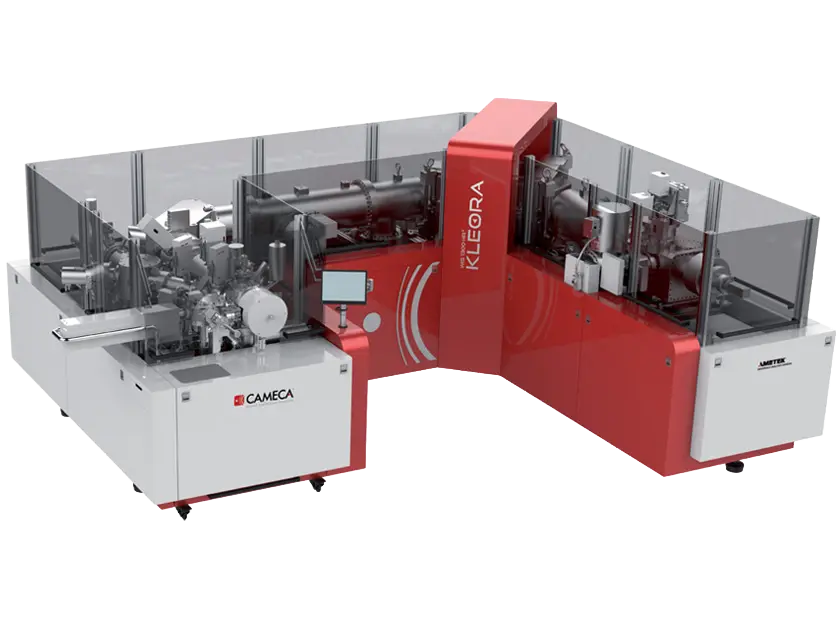
Manufacturer: CAMECA — France
Overview
KLEORA is a specialized secondary ion mass spectrometer (SIMS) from CAMECA, purpose-built for high-throughput U-Th-Pb isotope geochronology. Based on the large-geometry IMS 1300-HR³ ion microprobe platform, it combines high reproducibility, high spatial resolution and high mass resolution to deliver benchmark sensitivity for in-situ dating of zircon and other U-rich minerals such as apatite, rutile and baddeleyite. The instrument's RF-plasma oxygen ion source, automated sample handling and oxygen flooding technique enable precise, reproducible spot analyses at a rate of about five analyses per hour without compromising data quality. Dedicated geochronology software streamlines data reduction and age calculation directly from raw SIMS files. KLEORA can be upgraded to a full IMS 1300-HR³ configuration at any time, protecting the initial investment as research needs grow.
Measurement Principle
KLEORA is a secondary ion mass spectrometer (SIMS) that bombards the sample surface with a focused primary ion beam to sputter and ionize atoms from the outermost atomic layers. The resulting secondary ions are extracted, mass-analyzed, and counted to determine precise U-Th-Pb isotope ratios directly from mineral grains. This in-situ approach reveals age complexities within individual crystals or sub-grain domains that bulk analysis methods cannot resolve.
Large-Geometry Design and Mass Resolution
KLEORA is built on CAMECA's large-geometry IMS 1300-HR³ platform, which provides high ion transmission even at high mass resolution. This capability is essential for eliminating interfering molecular ions while analyzing the very low Pb concentrations typical of U-Pb geochronology samples. A mass resolution of 5500 (M/ΔM) has been demonstrated to fully separate the 206Pb peak from isobaric molecular interferences such as 94Zr96Zr16O.
High-Brightness RF-Plasma Ion Source
A new high-brightness RF-plasma oxygen ion source delivers greatly enhanced beam density and current stability compared to earlier CAMECA instruments. It enables small spot sizes with high beam density, from tens of microns down to 0.5 µm, with primary current densities exceeding 100 mA/cm² and 10 mA/cm² respectively. This improves spatial resolution, long-term data reproducibility and analytical throughput.
Automated, High-Throughput Operation
KLEORA integrates an automated sample loading system with motorized sample-height (Z) adjustment, an auto-storage chamber for unattended multi-sample runs, and remote operation software. Together these features allow typically five U-Pb spot analyses per hour without compromising precision or lateral resolution. Pre-tuning at the factory means a new system is typically commissioned in less than six weeks.
Oxygen Flooding and Reproducibility
An oxygen flooding technique improves Pb sensitivity by up to a factor of seven and produces highly reproducible analytical conditions across long analytical sessions. Combined with the enhanced magnet control system, this yields benchmark long-term repeatability and reproducibility at high mass resolution. Age precision better than 0.3% (2σ) has been demonstrated on the 91500 zircon standard.
Ion Imaging and Depth Profiling
KLEORA offers superior ion imaging capabilities for trace-element mapping in zircon grains, revealing inhomogeneity and zonation with sub-micron lateral resolution in microscope mode and better than 0.5 µm in scanning ion imaging mode. A unique adjustable, small spot-size capability using Gaussian primary ion beam illumination, rather than conventional projected mode, enables U-Pb dating at scales below 5 µm with close to 1% age precision and accuracy. Optimized depth profiling delivers high sputtering rate, excellent sensitivity and wide dynamic range.
Geochronology Software and Applications
KLEORA includes a dedicated geochronology data reduction package, developed at NORDSIM by Dr. Martin Whitehouse, that runs on Microsoft Excel and directly imports SIMS data files for fast processing of large datasets. It supports multiple calibration methods, common-lead correction, age-table display and export for Concordia diagram plotting. Applications span precise age determination of zircon to dating of other U-rich minerals such as apatite, rutile and baddeleyite.
Common Specifications
| Specification | KLEORA |
|---|---|
| Platform | Based on the IMS 1300-HR³ large-geometry ion microprobe |
| Mass resolution (M/ΔM) | 5500 (demonstrated for Pb isotope separation) |
| Age precision | Better than 0.3% (2σ) on 91500 zircon standard |
| Throughput | Typically 5 U-Pb spot analyses per hour |
| Primary ion source | RF-plasma O⁻ source |
| Beam density (tens-of-micron spot) | > 100 mA/cm² |
| Beam density (0.5 µm spot) | > 10 mA/cm² |
| Minimum spot size | 0.5 µm |
| Scanning ion imaging resolution | Better than 0.5 µm |
| Microscope-mode imaging resolution | Sub-micron |
| Depth/spot-scale dating demonstrated | U-Pb dating at < 5 µm spot size |
| Oxygen flooding sensitivity gain | Up to a factor of 7 |
| Sample handling | Automated sample loading with motorized Auto-Z height adjustment |
| Optical microscope | High-resolution UV-light microscope |
| Typical commissioning time | Less than 6 weeks |
Configuration Comparison
| Specification | IMS 1300-HR³ | KLEORA |
|---|---|---|
| RF-Plasma O⁻ source | Included | Included |
| Cs microbeam source | Included | Not included |
| Auto-Z motion | Included | Included |
| Auto storage chamber | Included | Included |
| High resolution UV-light microscope | Included | Included |
| Oxygen flooding | Included | Included |
| Normal-incidence electron gun | Included | Not included |
| Multicollector system | Included | Not included |
| NMR control | Included | Not included |
| Geochronology software | Included | Included |