
Magnetic Sector SIMS: IMS 7f-GEO
The CAMECA IMS 7f-GEO is a compact, mono-collection magnetic sector Secondary Ion Mass Spectrometer developed specifically for high precision, high throughput geoscience measurements.
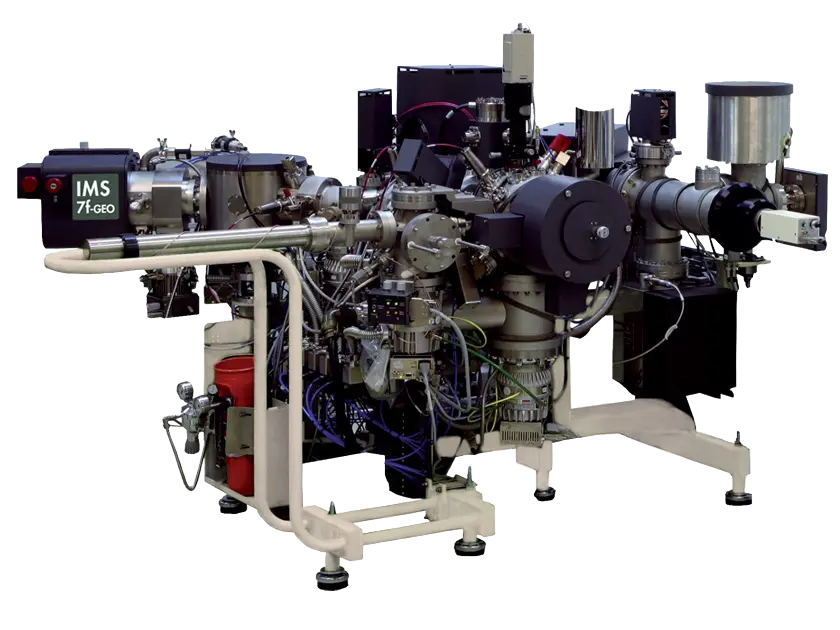
Manufacturer: CAMECA — France
Overview
The CAMECA IMS 7f-GEO is a compact, mono-collection magnetic sector Secondary Ion Mass Spectrometer developed specifically for high precision, high throughput geoscience measurements. Derived from the proven IMS 7f and IMS 1280 instruments, it combines a double Faraday cup detector system with an Electron Multiplier to achieve sub-permil precision on stable isotope ratios. A microbeam caesium ion source and a duoplasmatron source cover both electronegative and electropositive secondary ion emission, supporting elemental and isotopic analysis from hydrogen to plutonium. The instrument is fully computer controlled, including chained and unattended overnight operation, and is used for stable isotope ratio measurements, Rare Earth Element analysis and trace element mapping down to micron-scale spatial resolution.
Measurement principle and detection system
The IMS 7f-GEO uses a magnetic sector double-focusing mass spectrometer combined with a sextupole at the entrance of the magnet, which cancels second-order aberrations and allows a larger field aperture to be used at constant mass resolving power. A unique detection system pairs a double Faraday cup with an Electron Multiplier, and the double FC channels can be run in charge mode so that no settling time is required between isotope measurements. This configuration allows analyses to be run in a pseudo bi-collection mode that is particularly well suited to high precision stable isotope work.
Mass resolution and fast peak switching
A fast mass peak switching system combines magnetic and electrostatic beam deflection, using a Hall probe signal to apply electrostatic voltage feedback on the magnet flight tube during mass jumps. This achieves peak repositioning in as fast as 0.3 seconds at high mass resolving power, applicable across the full mass range including REE analysis. In a demonstrated example, a mass resolving power of 4400 (33S mass spectrum, MRP at 10%) was obtained while maintaining a flat-top peak with higher transmission thanks to the larger field aperture.
Primary ion sources and beam monitoring
The IMS 7f-GEO is equipped with a microbeam caesium ion source for negative secondary ion analysis and a duoplasmatron source for positive secondary ion work, both under full computer control. A primary Faraday cup coupled with fast beam blanking, together with quasi-continuous primary beam intensity monitoring, returns one primary intensity value per data point for reliable drift correction. The sample stage can be biased from -10 kV to +10 kV, and a UHV airlock system supports high vacuum quality analysis.
Stable isotope analysis performance
The double Faraday cup system running in charge mode delivers a major improvement in analysis throughput: an 18O/16O measurement requiring 0.4 permil precision that would take over 3000 seconds in EM/EM mode is completed in around 56 seconds. On synthetic quartz, spot-to-spot reproducibility of 0.37 permil and a mean internal error of 0.27 permil were demonstrated for oxygen isotope analysis using a highly focused Cs+ primary beam. Sulfur isotope analyses on microbial mats achieved external and internal errors of around 1 permil, substantially smaller than the natural variability observed within the samples.
Trace element and REE analysis
Using a high density O- primary beam combined with the mass spectrometer's high transmission, the IMS 7f-GEO measures trace elements including Rare Earth Elements at ppm concentration levels. Energy filtering technique is used to discriminate monoatomic species from molecular interferences, with analysis areas below 25 μm in diameter. REE ratio measurements on standard reference materials such as NBS 610 have demonstrated average standard errors below 0.2%.
Automation and software
The IMS 7f-GEO is fully computer controlled, covering ion sources, lenses, diaphragms, slits and the sample stage, and runs under a PC operating under MS Windows. A powerful chain analysis program allows overnight unattended operation across multiple analyses, and the software package covers instrument tuning and control, data acquisition and processing.
Common Specifications
| Specification | IMS 7f-GEO |
|---|---|
| Technique | Mono-collection dynamic and static SIMS, magnetic sector double-focusing mass spectrometer |
| Primary ion sources | Microbeam caesium ion source, duoplasmatron ion source |
| Detection system | Double Faraday cup detector system + Electron Multiplier |
| Mass peak switching speed | As fast as 0.3 sec at high MRP |
| Mass resolving power demonstrated | MRP(10%) = 4400 (33S) |
| Multicollection mode | Pseudo bi-collection using double FC in charge mode |
| 18O/16O measurement time (0.4‰ precision) | 56 sec (vs. >3000 sec in EM/EM mode) |
| Oxygen isotope reproducibility (spot-to-spot) | 0.37‰ |
| Oxygen isotope internal error | 0.27‰ |
| Sulfur isotope precision | ~1‰ (external and internal error) |
| REE analysis precision | Average standard error < 0.2% |
| FC resistor options | 10¹⁰ Ω (e.g. ¹⁶O), 10¹¹ Ω (e.g. ¹⁸O) |
| Sample bias range | -10 kV to +10 kV |
| Charge compensation | Normal Incidence Electron Gun (self-neutralization mode) |
| Vacuum | Ultra High Vacuum (UHV) analysis chamber for light element analysis |
| Data/image software | WinCurve, chain analysis program for unattended operation |