
Magnetic Sector SIMS: IMS 7f-Auto
The CAMECA IMS 7f-Auto is a fully automated, high-throughput magnetic sector Secondary Ion Mass Spectrometer built as the latest evolution of the field-proven IMS 7f platform.
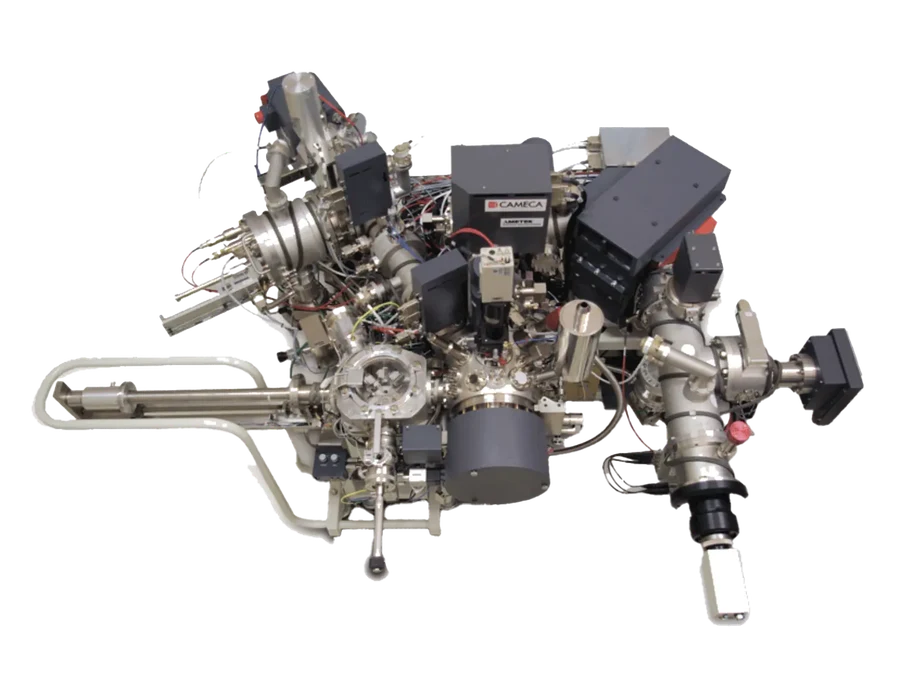
Manufacturer: CAMECA — France
Overview
The CAMECA IMS 7f-Auto is a fully automated, high-throughput magnetic sector Secondary Ion Mass Spectrometer built as the latest evolution of the field-proven IMS 7f platform. It combines a duoplasmatron oxygen source with a retractable caesium microbeam source to enable both electropositive and electronegative secondary ion analysis on a single instrument. The instrument is optimised for challenging materials such as glass, metals, ceramics, and III-V or II-VI compound semiconductors, delivering ultimate detection limits for dopants, impurities and light elements. A motorised storage chamber accommodating up to six one-inch sample holders, combined with automated tuning routines, allows chained and unattended analysis around the clock. It is widely used across semiconductor process control, photovoltaic and LED device development, material sciences and environmental studies.
Measurement principle and mass spectrometer
The IMS 7f-Auto is based on a magnetic sector double-focusing mass spectrometer inherited from the field-proven IMS 7f secondary column design. It provides high mass resolution together with fast peak switching, enabling separation of demanding mass interferences such as 31P from 30Si1H. The instrument supports both direct ion imaging (microscope mode) for day-to-day tuning and scanning ion imaging (microprobe mode) for sub-micron lateral resolution work. Successive 2D images can be recorded as a function of depth to build full 3D elemental reconstructions.
Primary ion sources and depth profiling
A source chamber allows simultaneous mounting of a duoplasmatron source and a retractable caesium microbeam source, so operators can switch between electropositive and electronegative secondary ion analysis under full computer control. An accel-decel extraction system enables operation with O2+ primary ions at impact energies as low as 500 eV, delivering excellent depth resolution for ultra-shallow implant profiling. Typical sputter rates of around half a micron per minute allow several microns of depth to be profiled within minutes while maintaining high sensitivity and dynamic range.
Detection system and sensitivity
Secondary ions are measured with a detection system combining one Faraday Cup and one Electron Multiplier, giving a counting dynamic range of ten decades. For the three main silicon dopants, boron, phosphorus and arsenic, detection limits in the ppb range are achievable, and metal contamination such as Cr, Fe, Ni and Cu can be detected with high sensitivity at Si/SiO2 interfaces. Optimised vacuum in the analysis chamber together with high-density caesium beam bombardment gives detection limits for light elements (H, C, N, O) that surpass competing techniques such as TOF-SIMS.
Automation and software
The IMS 7f-Auto is the first SIMS instrument designed to run fully unattended and automated measurements across multiple sample holders, with a motorised storage chamber holding up to six one-inch diameter holders under vacuum. New auto-tuning routines cover aperture centring, detector adjustment and parameter centring, minimising operator-related bias and improving reproducibility to below 0.5% RSD across windows and holders. WinCurve provides depth profiling and mass spectra data processing, while WinImage delivers image visualisation, ROI-based data reconstruction and batch processing, and the Checkerboard function optimises crater-edge rejection for improved depth resolution.
Applications in semiconductors and photovoltaics
In semiconductor process control, the IMS 7f-Auto profiles dopants and impurities in Si, SiC, III-V and II-VI device structures with ppb-level detection limits and analysis throughputs suited to production monitoring. For photovoltaics, it quantifies trace element concentrations in upgraded metallurgical-grade silicon feedstock with detection limits spanning ppb to ppm, typically achieving four to six analyses per hour. In LED device development it delivers depth profiles of dopants such as Mg and Si with detection limits better than 1E16 at/cm3, alongside high depth resolution suited to ultra-shallow implant characterisation.
Materials science and imaging capabilities
The instrument's 2D and 3D ion imaging capabilities make it well suited to metallurgical and materials research, including mapping of trace and major species with sub-micron lateral resolution. Studies using the IMS 7f-Auto have visualised hydrogen trapped at intermetallic particles in aluminium alloys and carbon segregation in steel samples. The Normal-Incidence Electron Gun provides effective charge compensation for insulating materials such as glass and diamond, ensuring stable signal and reliable quantitative analysis.
Common Specifications
| Specification | IMS 7f-Auto |
|---|---|
| Technique | Dynamic SIMS, magnetic sector double-focusing mass spectrometer |
| Primary ion sources | Duoplasmatron (O2+/O-) and retractable Cs+ microbeam source |
| Primary impact energy | As low as 500 eV (O2+ bombardment) |
| Detection system | One Faraday Cup and one Electron Multiplier |
| Detector dynamic range | 10 decades |
| Detection limit, Si dopants (B, P, As) | ppb range |
| Detection limit, Mg/Si in AlGaN/InGaN LED | < 1E16 at/cm³ |
| Detection limit, trace elements in PV Si feedstock | ppb to ppm range |
| Sputter rate (typical) | ~0.5 μm/min |
| Lateral resolution | Sub-micron (~1 μm demonstrated) |
| Reproducibility (dose measurement) | RSD < 0.5% |
| Automated storage chamber capacity | Up to 6 one-inch diameter sample holders |
| Charge compensation | Normal-Incidence Electron Gun (NEG) |
| Imaging modes | Direct (microscope) and scanning (microprobe) ion imaging, 3D reconstruction |
| Analysis throughput (UMG-Si trace elements) | 4-6 analyses/hour |
| Data/image software | WinCurve, WinImage, Checkerboard |
| Particle analysis option | Automated Particle Measurement (APM) software |