
Large Geometry SIMS: IMS 1300-HR³
The CAMECA IMS 1300-HR³ is a multicollection Large Geometry Secondary Ion Mass Spectrometer (LG-SIMS) that succeeds the internationally acclaimed IMS 1280-HR, combining high reproducibility at high spatial resolution with high mass resolution.
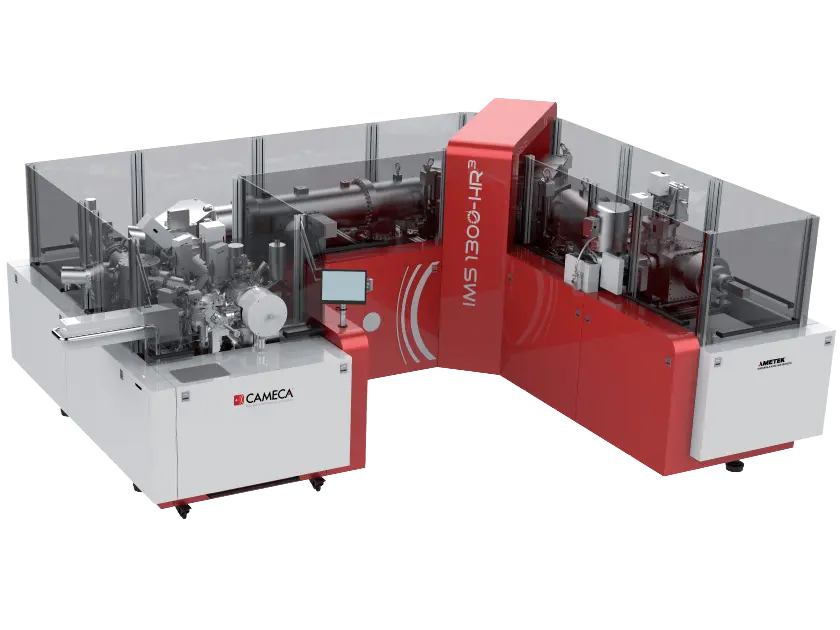
Manufacturer: CAMECA — France
Overview
The CAMECA IMS 1300-HR³ is a multicollection Large Geometry Secondary Ion Mass Spectrometer (LG-SIMS) that succeeds the internationally acclaimed IMS 1280-HR, combining high reproducibility at high spatial resolution with high mass resolution. It is based on a double focusing mass spectrometer with a large radius magnetic sector, equipped with two high brightness ion sources, an RF-plasma oxygen source and a caesium microbeam source, for analysis of both positive and negative secondary ions. A versatile multicollector system with up to seven detectors enables simultaneous isotope measurement, increasing throughput and precision for applications such as stable isotope geochemistry, U-Th-Pb geochronology and trace element analysis. The instrument also provides outstanding microprobe and microscope ion imaging, making it capable of mapping major, minor and trace elements or isotopes at sub-micron lateral resolution, and it is the reference technique for isotopic uranium particle analysis in nuclear safeguards.
Measurement principle and mass spectrometer
The IMS 1300-HR³ is built around a double focusing mass spectrometer with a large radius magnetic sector, with secondary ion optics optimised to combine high mass resolution with high sensitivity. Instrumental mass fractionation variability is minimised using automatic beam centering routines, and an enhanced magnet control system with NMR field regulation ensures long-term magnetic stability in multicollection mode. Mass peak shapes at a nominal mass resolving power of around 8000 have been demonstrated with the multicollector system.
Primary ion sources
The instrument is equipped with two high brightness ion sources, an RF-plasma oxygen source and a caesium microbeam source, which enhance secondary ion emission of electropositive and electronegative species respectively. The RF-plasma source provides significantly higher beam density than a conventional duoplasmatron source, delivering high spatial resolution, excellent data reproducibility and enhanced productivity for both large and small beam sizes. An oxygen flooding technique further improves sensitivity and analytical reproducibility, particularly for U-Pb geochronology.
Multicollector detection system
The field-proven multicollector system consists of five moveable collector units, each fitted with an adjustable collection slit and either an Electron Multiplier or a Faraday Cup, plus two additional Faraday cups on the extreme collector units, giving a total of seven detectors. This parallel detection system spans a large mass range from lithium to uranium isotopes, allowing simultaneous isotope measurement that increases throughput and precision. Discrete-dynode Electron Multipliers ensure negligible background and stable detector yield, while a dedicated 10¹² Ω resistor preamplifier board is available for measuring low secondary ion signal intensities with low noise.
Automated sample handling and imaging
The IMS 1300-HR³ uses the field-proven CAMECA motorised storage chamber, accommodating up to six sample holders with fully automated, computer-controlled holder exchange and sample outgassing. Automated Z-positioning maintains a constant distance between the sample surface and extraction plate, which is mandatory for high precision measurements, and a UV-light microscope developed with the University of Wisconsin improves optical image resolution for sample navigation. The instrument supports both microprobe (scanning) and microscope (direct) ion imaging, with up to five images recorded simultaneously in multicollection mode and down to sub-micron lateral resolution.
Applications in geochronology and stable isotopes
High mass resolution separates Pb isotopes from HfSi molecular interferences, while high transmission and oxygen flooding support analysis of low lead concentrations for U-Th-Pb dating of zircon and other U-rich minerals. The Normal-incidence Electron Gun provides efficient charge compensation for insulating samples, and the multicollector system delivers excellent reproducibility for stable isotope ratio measurements including carbon, oxygen, sulfur, lithium, magnesium and boron. A dedicated Geochronology data reduction software package, developed at NORDSIM, handles direct import of SIMS files, multiple calibration methods and Concordia diagram export.
Nuclear particle and trace element analysis
The IMS 1300-HR³ is the reference technique for isotopic uranium particle analysis in nuclear safeguards, with parallel multicollection of all uranium isotopes shortening acquisition times and enabling analysis of sub-micron particles. Combined with the Automated Particle Measurement (APM) software, the instrument performs fast screening of samples, identifying thousands of particles within a few hours and re-analysing selected particles at microbeam resolution for precise isotopic composition. High density oxygen and caesium primary beams also support trace and Rare Earth Element analysis at ppm concentration levels or below, with ion imaging capabilities for elemental and isotopic mapping.
Common Specifications
| Specification | IMS 1300-HR³ |
|---|---|
| Technique | Large Geometry multicollection SIMS (LG-SIMS), double focusing magnetic sector |
| Primary ion sources | RF-plasma oxygen source, caesium microbeam source |
| Multicollector detectors | Up to 7 (5 moveable collector units + 2 extreme FCs), EM or FC per unit |
| Mass range (multicollection) | Li to U isotopes |
| Nominal mass resolving power | ~8000 (multicollector system) |
| Demonstrated mass resolution (17O, FC/FC/FC) | ~7000 |
| FC electrometry option | 10¹² Ω resistor board for low signal intensities |
| Lateral resolution | Sub-micron (microprobe imaging) |
| Simultaneous ion images (multicollection) | Up to 5 |
| Automated storage chamber capacity | Up to 6 sample holders, motorized exchange |
| Charge compensation | Normal-incidence Electron Gun (NEG) |
| Uranium isotope precision (CRM U100, RSD) | 0.01% - 0.59% depending on isotope |
| Particle screening throughput (APM) | Thousands of particles within a few hours |
| Field of view (APM screening example) | 500 x 500 μm² |
| Optical imaging | UV-light microscope for sample navigation |
| Data/image software | Geochronology, WinCurve, WinImage |