
Automatic Dropping Point Tester: RDP-202 (2 Units)
The RDP-202 automates the standard test method for determining the dropping point of lubricating grease in accordance with JIS K2220, ASTM D566, IP 132 and ISO 2176.
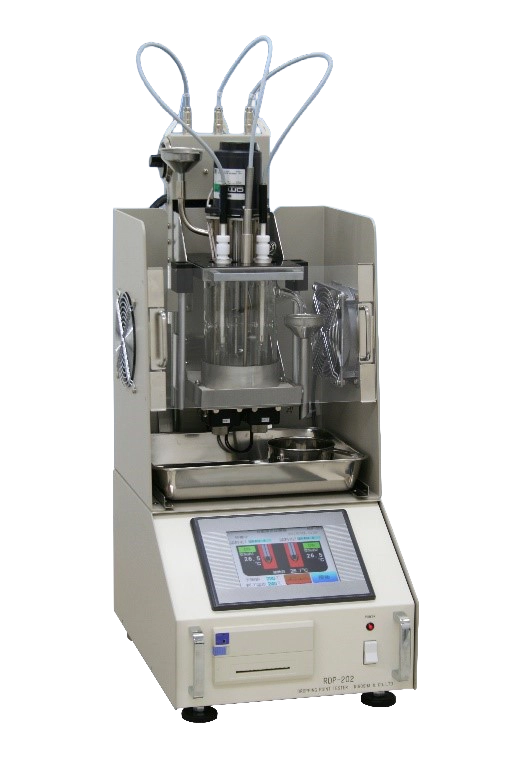
Manufacturer: Rigo — Japan
Overview
The RDP-202 automates the standard test method for determining the dropping point of lubricating grease in accordance with JIS K2220, ASTM D566, IP 132 and ISO 2176. The operator fills the grease sample into a test tube fitted with a heating bath cup, sets the expected dropping point temperature, and starts the test; the instrument then agitates and heats the sample at the specified rate while an optical sensor at the base of the tester detects the moment the grease drop falls. Results are shown on a touch-panel color LCD, printed by the built-in printer, and output through an RS-232C port. A Rapid mode allows fast measurement of samples with dropping points above 200°C, and the heating bath is cooled automatically by twin fans after each test. The dropped grease is caught in a magnetic quick-release tray that can be removed and cleaned in seconds, and the overflow-drain heating bath keeps the silicone oil level constant without manual adjustment.
Touch-Panel Operation
The RDP-202 is controlled entirely through a graphical color touch-panel LCD, making it accessible to any operator regardless of experience. Each stage of the test, together with the current temperature of every monitored zone, is displayed in real time as the run progresses. Calibration data can be entered with a single touch and stored on a USB memory stick for traceability.
Dual-Holder Heating Bath
The glass heating bath accommodates two sample holders and includes an overflow drain that captures silicone oil as it expands with rising temperature. This keeps the bath liquid level constant throughout the test without any manual topping-up. After each measurement the bath is cooled automatically by an axial air-cooling fan.
Data Output and Records
Test results are printed automatically by the built-in Citizen thermal printer, which records the channel, sample name, date and time, and the measured result. The RS-232C output allows results to be transferred directly to a computer or laboratory information system at a fixed 9600 bps.
Common Specifications
| Specification | RDP-202 (2 Units) |
|---|---|
| Applicable Standards | JIS K2220, ASTM D566, IP 132, ISO 2176 |
| Sample Holders | 2 holders |
| Measuring Temperature Range | 50°C to 300°C |
| Temperature Resolution | ±0.1°C |
| Dropping Point Detection | Photoelectric method |
| Heating Bath | Glass, with overflow drain, approx. 0.7 L |
| Agitation Motor | Condenser motor, 6 W, with speed adjustment |
| Heater | 350 W (2 x 175 W flange heaters) |
| Air Bath Temperature Sensor | Platinum sensor, glass-coated, Pt100Ω |
| Bath Liquid Temperature Sensor | Platinum sensor, stainless steel, Pt100Ω |
| Cooling Method | Air cooling by axial fan |
| Temperature Control | PID control by time-proportioning method |
| Display | Touch-panel color LCD |
| Printer | Built-in thermal printer (Citizen CBM-920II 24RJ) |
| External Output | RS-232C, 9600 bps |
| Power Source | 100 V AC, 50/60 Hz, 5 A |
| Dimensions | Approx. 280 (W) x 370 (D) x 650 (H) mm |
| Weight | Approx. 10 kg |