
Dynamic Shear Rheometer: SmartPave 93 and SmartPave 303
The dynamic shear rheometers SmartPave 93 and SmartPave 303 enable precise measurements of asphalt binder and bitumen. Features such as Toolmaster, QuickConnect, and Peltier temperature control make standards-compliant asphalt testing fast, safe, and convenient.
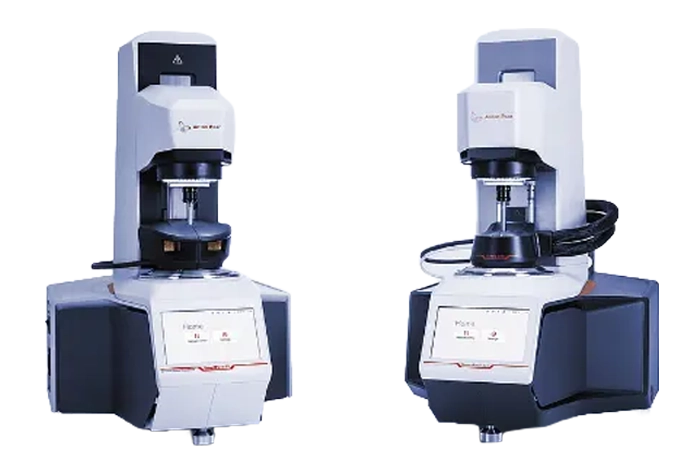
Manufacturer: Anton Paar — Austria
Overview
The dynamic shear rheometers (DSR) SmartPave 93 and SmartPave 303 enable precise measurements of asphalt binder and bitumen. Features such as Toolmaster, QuickConnect, a Peltier temperature device for dry sample heating, and step-by-step instructions for measuring procedures according to AASHTO T315, AASHTO T350, AASHTO TP101, ASTM D7175, ASTM D7405, and DIN EN 14770 guarantee convenient operation. For measurements according to AASHTO T316, ASTM D4402, and DIN EN 13302, both instruments can be equipped with a Peltier-controlled measurement chamber for concentric cylinder geometries.
Two Models: Full-Spectrum Rheological Asphalt and Bitumen Testing
The well-established SmartPave dynamic shear rheometers analyze unmodified and modified asphalt binder and bitumen within a wide temperature range, either according to standards, or by means of classic rheological methods. SmartPave 303 meets the highest measurement demands across the board. SmartPave 93 is designed especially for the demands of quality control and routine measurements in asphalt testing labs.
The Ultimate Rheometer Software
RheoCompass is market-leading rheometer software delivering a complete overview and detailed insights. It contains numerous templates tailored specifically to use of the dynamic shear rheometer in the asphalt industry. The predefined test procedures include step-by-step instructions for all test types as defined by AASHTO, ASTM, DIN EN, and FGSV. Templates are regularly updated to ensure you always comply with the latest version of your standard.
Unique Accessories for Easy Handling
The unique temperature control unit of SmartPave 93 and SmartPave 303 is the first Peltier heating system with heating elements above and below the sample – combined with the widest temperature range. Both instruments also include Toolmaster. The only completely contact-free automatic tool recognition and configuration system for rheometers, it recognizes measuring systems and temperature control units as soon as they are connected to the rheometer, eliminating the need for manual data entry.
Fully Automatic Temperature Calibration
Temperature accuracy and stability are crucial in asphalt testing. Anton Paar offers fully automatic temperature calibration and verification routines via the RheoCompass software. The unique automatic calibration routine ensures temperature gradients of <0.1 °C, tailored specifically for asphalt workflows using the SmartPave dynamic shear rheometer.
Upgrade your SmartPave DSR to a BBR
Enhance your SmartPave 303 or 93 with a specialized software solution from our cooperation partner, Pavement Systems LLC. Connect effortlessly to this external analysis software and unlock a range of features, including iCCL testing. This powerful method (a surrogate of BBR [AASHTO PP112]) provides low-temperature PG-grade, m-value, stiffness (S), and ΔTc results – all within 30 minutes.
Experienced Experts on Hand
Anton Paar’s worldwide service network ensures that an expert on your system is always nearby. Numerous installed instruments around the globe, an extensive application database, and cooperation with civil engineering institutes make it clear: Anton Paar is number one for answers to rheological questions about asphalt binder and bitumen.
Models
Dynamic Shear Rheometer: SmartPave is available in 2 models: SmartPave 93, SmartPave 303.
SmartPave 93
Quality control and routine measurements of asphalt and bitumen.
SmartPave 303
Rheometer for research and development of asphalt and bitumen.
Specifications
| Specification | SmartPave 93 | SmartPave 303 |
|---|---|---|
| Bearing Design | Air, fine-pored carbon | |
| Motor Design | Electronically Commutated (EC) - Permanent Magnet Synchronous Motor | |
| Displacement Transducer Design | High-resolution optical encoder | |
| Normal Force Measurment Design (US Pat. 6167752,1996) | - | 360 ° capacitive sensor, non-contacting, fully integrated in bearing |
| Working Mode | Combined Motor Transducer (CMT) | |
| Minimum Torque (rotation) | 80 nNm | 5 nNm |
| Minimum Torque (oscillation) | 80 nNm | 1 nNm |
| Maximum Torque | 160 mNm | 215 mNm |
| Minimum Angular velocity ¹⁾ | 0 rad/s | |
| Maximum Angular Velocity | 261 rad/s | 314 rad/s |
| Maximum Speed | 2500 1/min | 3000 1/min |
| Minimum frequency ²⁾ | 10⁻⁷ Hz | 2 x 10⁻⁸ Hz |
| Maximum frequency ³⁾ | 100 Hz | 200 Hz |
| Normal Force Range | -50 to +50 N | |
| Dimensions (W x H x D) | 442 x 725 x 596 mm | 453 x 725 x 673 mm |
| Three-point Support of Device (three Robust Feet for Tool-free One Hand Alignment) | Yes | |
| Three-point Support for Mounting of Measuring Cells (wobble Prevention, No Misalignment After Changing of Cells) | Yes | |
| Maximum Temperature range ⁴⁾ | -50 to +400 °C | -170 to +1000 °C |
| Virtually Gradient-free Temperature Control (horizontal,vertical) | Yes | |
| Temperature Gradient <0.1 °C According to Aashto and ASTM | Yes | |
| CoolPeltier™ Peltier System with Built-in Cooling Option that Does Not Require Additional Accessories for Counter Cooling | -5 to +200 °C | |
| Pressure Cell | up to 170 bar | up to 1000 bar |
| TruRay™ Dimmable Illumination of Sample Area | Yes | |
| RheoCompass Software | ||
| Asphalt Standard Operation Procedures (SOP) with Regular Updates | Yes | |
| Fully Automatic Temperature Calibration | Yes | |
| Test and Analysis Designer | Yes | |
| Report Designer (with All Test Information for Export and Print) | Yes | |
| Managed Lab Multiple Clients and Servers | Optional | |
| Notes | ¹⁾ In controlled shear stress (CSS) mode. In controlled shear rate (CSR) mode, depending on measuring point duration and sampling rate. ²⁾ Theoretical value (duration per cycle = 2 years) ³⁾ Higher frequencies are possible using multi-wave functionality (942 rad/s (150 Hz) or even higher, depending on measuring system and sample) ⁴⁾ Depending on used temperature device |