
Energy-Dispersive XRF Spectrometer: JSX-1000S Element Eye™
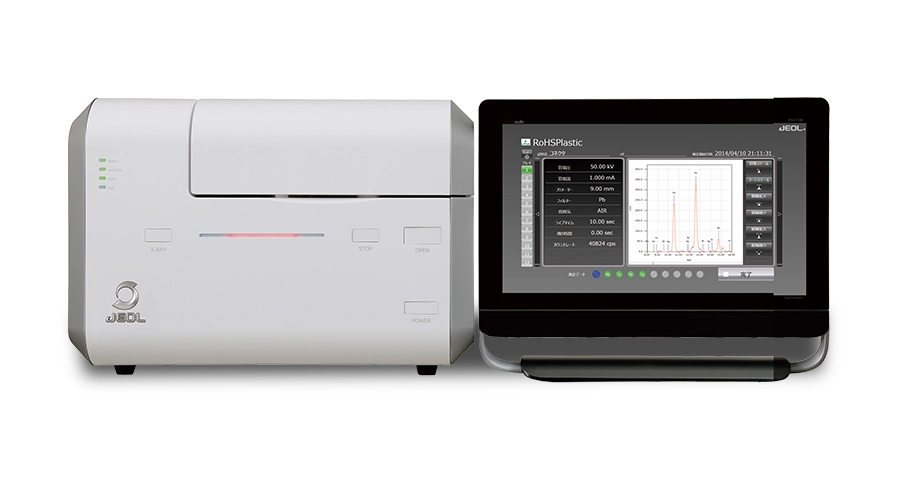
The JSX-1000S Element Eye™ is a benchtop energy-dispersive X-ray fluorescence spectrometer offering quick, easy elemental analysis by touch panel, with FP and calibration-curve quantification, RoHS screening, and high-sensitivity detection from magnesium to uranium.
Manufacturer: JEOL — Japan
Overview
The JSX-1000S Element Eye™ is an energy-dispersive X-ray fluorescence spectrometer that provides quick, easy elemental analysis using touch-panel operation — a smart solution for ultimate analysis. It is equipped with functions for conventional qualitative and quantitative analysis (FP method, calibration curve method) as well as screening for RoHS elements, and with a variety of hardware and software options it is customizable to cover a wide range of analysis needs. XRF requires little or no sample preparation, making elemental analysis accessible to more users.
Simple Operation: Set and Touch
Simply set the sample and touch the screen — that is how easy it is to operate. Analysis values and pass/fail assessment results are updated in real time, and another touch switches between analysis results and spectrum display, with a swipe of the screen changing the view. The interface is as easy to operate as a tablet or smartphone, while conventional keyboard-and-mouse operation is also supported.
Sensitive Analysis Throughout the Entire Energy Range
Based on many years of experience, JEOL has incorporated proprietary algorithms into the Fundamental Parameter (FP) method for highly accurate qualitative and quantitative results without a standard sample. JEOL's own SDD (silicon drift detector) and a newly developed optical system, combined with up to nine automatically exchanged primary filters designed to cover the entire energy range — open, ND, Cr, Pb, and Cd as standard, with Cl, Cu, Mo, and Sb optional — achieve high-sensitivity analysis from fluorine to uranium. The optional sample chamber vacuum unit further increases detection sensitivity for lighter elements (F to Al).
High-Precision Quantitative Analysis with Smart FP
The new Smart FP (Fundamental Parameter) method obtains highly accurate quantification results without preparing a standard sample, and includes automatic correction for sample thickness and residual ingredient balance (applicable to organic samples). In polyethylene reference testing, corrected results for Cr, Zn, Cd, and Pb agree closely with certified standard values regardless of whether the specimen is 0.5 mm or 3.8 mm thick.
High Throughput
The new high-sensitivity SDD and a short-path optical system achieve throughputs up to 7.6 times faster than the previous JEOL system (JSX-3100R II) in Cd and Pb trace measurements on PVC and brass — detecting concentrations of 10 ppm and below in routine screening.
Providing Solutions
With solution-based applications, the desired analysis is executed automatically according to pre-recorded recipes — simply select the solution icon from the application list for automated analysis and display of results. Standard solutions cover RoHS analysis of metals and organic materials and simple analysis of metals, oxides, and organic materials in air or vacuum; optional solutions add Ni plating screening, Sn plating screening, and halogen screening.
Smart Assist for Other Analytical Techniques
Element Eye™ speeds up work on JEOL's other analytical instruments. As a SEM-EDS assist, XRF quickly determines whether a target element such as zirconium is present in a bulk sample before SEM-EDS pinpoints which particles contain it. As an XPS thin-film assist, XRF measures the thickness of each layer in a multilayer sample — for example Cu/Ni/Cr on polyimide — so optimal etching conditions can be set in advance of a depth profile. As an NMR fluid-sample assist, XRF determines the types and concentrations of elements such as platinum in a sample, enabling appropriate NMR acquisition conditions to be estimated beforehand.
Options
Hardware options include the sample chamber vacuum unit, an auto sample changer that exchanges up to 12 samples automatically for continuous acquisition, a high-sensitivity collimator, additional filter sets, and a UTW detector. Software options include filter FP method analysis, thin-film FP method analysis for layer thickness, sum peak removal, and the Ni plating, Sn plating, and halogen screening solutions. A low vacuum capsule enables helium-free light-element analysis in liquid samples.
Specifications for JSX-1000S Energy-Dispersive X-Ray Fluorescence Spectrometer
| Specification | JSX-1000S |
|---|---|
| Detectable Element Range | Mg to U; F to U with sample chamber vacuum unit (option) |
| X-Ray Generator | 5 kV to 50 kV, 1 mA |
| Target | Rh |
| Primary Filters | Maximum of 9 types, automatic exchange; standard: open, ND (neutral density), Cr, Pb, Cd; optional: Cl, Cu, Mo, Sb |
| Collimators | 3 types, automatic exchange: 0.9 mm, 2 mm, 9 mm |
| Detector | Silicon drift detector (SDD) |
| Sample Chamber Size | Ø 300 mm × 80 mm (H) |
| Sample Chamber Atmosphere | Air / vacuum (option) |
| Sample Observation | Color camera |
| Operation Computer | Windows® desktop computer with touch panel |
| Analysis Software (Standard) | Qualitative analysis (auto qualitative, KLM marker, sum peak display, spectrum search); quantitative analysis (bulk FP method, calibration curve method); RoHS solution (Cd, Pb, Cr, Br, Hg); simple analysis solution; report generation tool |
| Daily Check Software (Standard) | Tube aging, energy check, intensity check |
| Main Options | Sample chamber vacuum unit; auto sample changer (up to 12 samples); high-sensitivity collimator; filter set; UTW detector; filter FP, thin-film FP, and sum peak removal software; Ni plating, Sn plating, and halogen screening solutions |
| Power Supply | Single-phase AC 100 V to 120 V ±10% (max. 125 V) or 200 V to 240 V ±10% (max. 250 V), 50/60 Hz, 1.5 kVA; Class D grounding (100 Ω or less) |
| Installation Environment | Temperature 18 °C to 28 °C; humidity 30% to 70% (no condensation); free of corrosive gas, dust, and discernible vibration |
| Main Unit Dimensions and Weight | 600 mm (W) × 560 mm (D) × 430 mm (H); 64 kg |
| Notes | Leave a maintenance space of at least 50 cm on all sides. Legal documentation is required for instruments using X-rays, according to the regulations of the country of use. |