
Rheo-Raman System: MCR Rheometer + Cora 5001
The Rheo-Raman setup – an MCR rheometer integrated with a Cora 5001 Raman spectrometer – combines two powerful measurement principles: the mechanical insights of rheology and the molecular specificity of Raman spectroscopy.
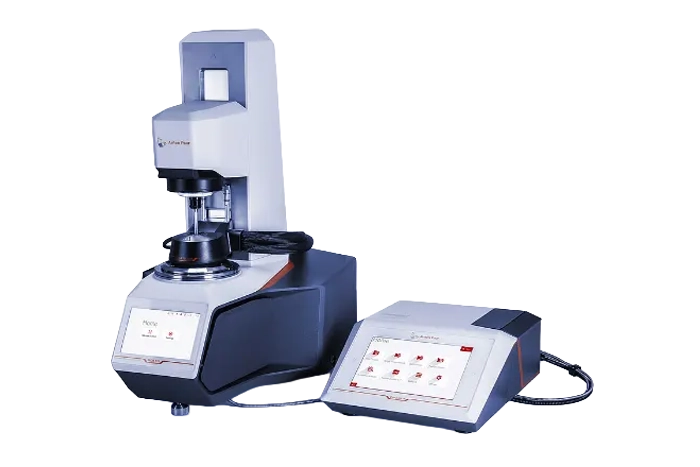
Manufacturer: Anton Paar — Austria
Overview
The Rheo-Raman setup – an MCR rheometer integrated with a Cora 5001 Raman spectrometer – combines two powerful measurement principles: the mechanical insights of rheology and the molecular specificity of Raman spectroscopy. By linking rheological behavior with structural parameters from Raman spectra, academic researchers can uncover the molecular origins of viscoelastic properties – replacing hypotheses with proof and enabling publication of papers in high-impact journals. In industry, the Rheo-Raman system supports efficiency gains by reducing trial-and-error cycles, identifying deviations, pinpointing their root causes, and enabling precise corrective actions.
Reduce your Time-to-Market with Fewer Development Cycles
In polymer and resin product development, desired properties are often achieved via experience combined with time-consuming iterative trial and error processes. By adding chemical insights to physical measurements through the Rheo-Raman approach, development teams gain a clear picture of what drives material performance. This enables more targeted optimization, reduces the number of development cycles, saves costs, and shortens time-to-market.
Boost your Research Results for the Next Higher-Grade Publication
In academic research, rheological measurements alone often lead to observational results without a clear molecular explanation. By combining rheological results with chemical and molecular insights, researchers gain scientific proof – not just hypotheses.
This deeper understanding supports publication in higher-grade journals, increases visibility at top conferences, and strengthens applications for research funding – fueling a continuous cycle of scientific advancement.
Key application areas are: material science, polymer science, resins, glues and adhesives, including photo polymerization, for which simultaneous UV exposure and Raman offer strong advantages.
Optimize your Polymer Production Processes
Developing new polymer production processes, including the right parameters, often involves repeated iterations that consume time and capacity. The valuable information acquired through a combination of physical measurements and chemical insights using the Rheo-Raman setup makes defining process windows more focused and efficient. This approach helps minimize trial and error, accelerates process refinement, reduces costs, and brings products to market faster.
Benefit from the Rheo-Raman System – or Use the Instruments Separately
Due to cumbersome integration and alignment procedures that require specialized skills, similar systems on the market can only be used in combination. In contrast, the Rheo-Raman setup with MCR and Cora 5001 can be assembled or disassembled by users in just a minute. A visit from a service technician is not required. You can use the rheometer and Raman analyzer separately or combine them, depending on your measurement needs. This means you're getting three solutions in one – from one and the same supplier. We guarantee that both the individual and combined solutions will work seamlessly together.
More Effective QC with Root Cause Analysis down to Molecular Origins
In industrial QC of polymer products such as polymer melts, adhesives, and resins, resolving deviations is often a slow, trial-and-error process based on observations and user experience. Offline testing adds further delays and unnecessary costs, while quality issues remain unresolved.
By combining rheology with Raman spectroscopy, users gain real-time, in situ chemical insights directly in the rheometer. This enables immediate identification of chemical/molecular root causes and allows for fast, targeted corrective action – reducing costs, avoiding liability risks, and keeping processes on track.
Specifications for Modular Compact Rheometer: MCR
| Specification | MCR 303 | MCR 503 | MCR 503 Power |
|---|---|---|---|
| Bearing Design | Air, fine-pored carbon | ||
| Motor Design | Electronically commutated (EC) permanent magnet synchronous motor | ||
| Displacement Transducer | High-resolution optical encoder | ||
| Normal Force Measurement Design | 360° capacitive sensor, non-contacting, fully integrated in bearing | ||
| Working Modes | CMT | ||
| Min. Torque (rotation) | 5 nNm | 1 nNm | 100 nNm |
| Min. Torque (oscillation) | 5 / 1 nNm ¹⁾ | 0.2 nNm | 50 nNm |
| Max. Torque | 215 mNm | 230 mNm | 300 mNm |
| Torque Resolution | 0.1 nNm | 0.05 nNm | 0.2 nNm |
| Angular Deflection Resolution | 3 nrad | < 1 nrad | < 1 nrad |
| Min. Angular Velocity ²⁾ | 0 rad/s | ||
| Max. Angular Velocity / Max. Speed | 314 rad/s 3,000 rpm | 314 rad/s 3,000 rpm | 200 rad/s 2,100 rpm |
| Min. Frequency ³⁾ | 2 Hz x 10⁻⁸ Hz | ||
| Max. Frequency | 100 Hz | 200 Hz | 200 Hz |
| Normal Force Range | 0.001 N to 50 N | 0.001 N to 50 N | 0.01 N to 70 N |
| Normal Force Resolution | 0.1 mN | ||
| TruStrain | o | ✓ | ✓ |
| Ready for DMA in Tension, Bending, and Compression ⁴⁾ | x | ✓ | ✓ |
| Dimensions (W x H x D) | 453 mm x 725 mm x 673 mm | 453 mm x 775 mm x 673 mm | 453 mm x 775 mm x 673 mm |
| Weight | 48 kg | 50 kg | 50 kg |
| Notes | ✓ included | o optional | x not included ¹⁾ 1 nNm with activated TruStrain™ option. ²⁾ In controlled shear stress (CSS) mode. In controlled shear rate (CSR) mode depending on measuring point duration and sampling rate. ³⁾ Theoretical value (duration per cycle = 2 years). ⁴⁾ US Pat. 9574983 and US Pat. 10908058. |
Specifications for Dual-Wavelength In-Situ Raman Spectrometer: Cora 5001 Fiber
| Specification | Single-wavelength 532 nm | Single-wavelength 785 nm | Single-wavelength 1064 nm | Dual-wavelength 532 nm and 785 nm | Dual-wavelength 532 nm and 1064 nm | Dual-wavelength 785 nm and 1064 nm |
|---|---|---|---|---|---|---|
| Optical Specifications | ||||||
| Excitation Wavelength | 532 nm | 785 nm | 1064 nm | 532 nm and 785 nm | 532 nm and 1064 nm | 785 nm and 1064 nm |
| Spectral Range | 200 cm⁻¹ to 3500 cm⁻¹ | 100 cm⁻¹ to 2300 cm⁻¹ | 100 cm⁻¹ to 2300 cm⁻¹ | 200 cm⁻¹ to 3500 cm⁻¹ for 532 nm 100 cm⁻¹ to 2300 cm⁻¹ for 785 nm | 200 cm⁻¹ to 3500 cm⁻¹ for 532 nm 100 cm⁻¹ to 2300 cm⁻¹ for 1064 nm | 100 cm⁻¹ to 2300 cm⁻¹ for 785 nm and 1064 nm |
| Resolution (according to ASTM E2529) | 9 cm⁻¹ to 12 cm⁻¹ | 6 cm⁻¹ to 9 cm⁻¹ | 12 cm⁻¹ to 17 cm⁻¹ | 9 cm⁻¹ to 12 cm⁻¹ for 532 nm 6 cm⁻¹ to 9 cm⁻¹ for 785 nm | 9 cm⁻¹ to 12 cm⁻¹ for 532 nm 12 cm⁻¹ to 17 cm⁻¹ for 1064 nm | 6 cm⁻¹ to 9 cm⁻¹ for 785 nm 12 cm⁻¹ to 17 cm⁻¹ for 1064 nm |
| Laser Power | 50 mW** | 0 mW to 450 mW*, adjustable | 0 mW to 450 mW*, adjustable | 50 mW* for 532 nm 0 mW to 450 mW* for 785 nm | 50 mW* for 532 nm 0 mW to 450 mW* for 1064 nm | 0 mW to 450 mW* for 785 nm and 1064 nm |
| Spectrograph | f/2; Transmission volume phase grating (VPG) | |||||
| Integration Time | 0.005 s to 600 s | 0.005 s to 600 s | 0.001 s to 20 s | 0.005 s to 600 s for 532 nm and 785 nm | 0.005 s to 600 s for 532 nm 0.001 s to 20 s for 1064 nm | 0.005 s to 600 s for 785 nm 0.001 s to 20 s for 1064 nm |
| Wavelength Calibration | Automatic via software | |||||
| Detector Array | 2048 px CCD | 2048 px CCD | 256 px InGaAs | 2048 px CCD for 532 nm and 785 nm | 2048 px CCD for 532 nm 256 px InGaAs for 1064 nm | 2048 px CCD for 785 nm 256 px InGaAs for 1064 nm |
| Laser Class | 3B for Fiber model | |||||
| Physical Specifications | ||||||
| Dimensions (D x W x H) | 355 mm x 384 mm x 168 mm (14.0 in x 15.1 in x 6.6 in) | |||||
| Weight | 9.8 kg | |||||
| Operating Range | 10 °C to 35 °C (non-condensing) | |||||
| Fiber Probe Dimensions | Cable length: 1.50 m | |||||
| Battery (optional) | Lithium-ion | |||||
| Battery Run Time | >1.5 h | |||||
| Power Supply Input | Line power supply input: 115/230 V AC, 50/60 Hz Car power adapter input: 9 V to 32 V DC | |||||
| Power Consumption | In-line power supply input: max. 100 VA DC input: typical 30 VA (60 VA when optional battery is charged) | |||||
| Additional Specifications | ||||||
| Display | 10-inch touch screen | |||||
| Data Ports | 4 x USB 2.0, 1 x Ethernet, 1 x CAN out and 1 x USB to PC | |||||
| Data Export Formats | .csv, .txt, .png, .spc,. aps, .pdf | |||||
| Internal Storage | 8 GB | |||||
| Wireless Connectivity | Wi-Fi stick (optional) | |||||
| Spectral Libraries | Factory library, user-built, third-party options | |||||
| Security | User roles with customizable permissions, user password logins | |||||
| Notes | *at sample **at laser source |