
Microwave Reactor with In-Situ Raman Spectroscopy: Monowave 400 R
Combine Monowave 400 R with the Cora 5001 Raman spectrometer to receive a spectrum of information out of a former black box. Anton Paar unites two powerful techniques for synthetic chemistry: rapid microwave synthesis and in-situ Raman monitoring of the running reaction.
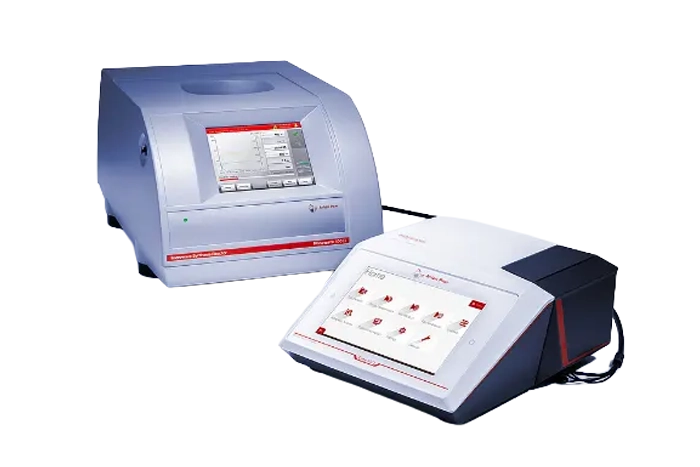
Manufacturer: Anton Paar — Austria
Overview
Combine Monowave 400 R with the Cora 5001 Raman spectrometer to receive a spectrum of information out of a former black box. Anton Paar combines two powerful techniques for synthetic chemistry – the microwave reactor Monowave 400 R delivers high-speed chemical reactions and the Raman analyzer Cora 5001 adds molecular spectroscopy for their characterization. Gain a better understanding of reaction mechanisms and kinetics by combining precise temperature profiles with real-time information about the chemical composition of a reaction mixture. Optimize reaction conditions based on deeper insights, such as the influence of parameters, the role of different reagents, or detection of the ideal end point of a reaction.
Study Chemical Reactions under Unprecedented Reaction Conditions
Monowave 400 R provides the full range of operational parameters with temperatures of up to 300 °C and pressures of up to 30 bar. The Cora 5001 Raman analyzer performs time series measurements with adjustable intervals and exposure times during reactions, directly inside the reaction vial. The microwave reactor and the Raman spectrometer are connected via a special fiber-optic Raman probe.
Real-Time In-Situ Reaction Monitoring for a Deeper Understanding of Reaction Mechanisms
Raman spectroscopy provides direct identification of functional groups and quantitative information about the composition of a reaction mixture. Detect non-isolable intermediates or short lifetime transitional states with time-resolved measurements for a deeper understanding of reaction mechanisms.
Applications include:
- Identification of reactive intermediates
- Elucidation of reaction mechanisms
- Investigation of reaction kinetics
- Monitoring of byproduct formation
- Optimization of reaction conditions
Like a New Probe Every Time with Contactless Measurement
The Raman probe employs a scattering method and can therefore be operated through the wall of the borosilicate glass vial for direct monitoring of the chemical composition of pressurized reactions. You can investigate various scales from 2 mL to 20 mL as the focus of the laser beam can be positioned optimally for both sizes of reaction vessels available with Monowave 400 R. With contactless measurement there is no cross-contamination, you have a free choice of reactants, and have no cleaning efforts between experiments.
Precise Temperature Control for Perfect Repeatability of the Reaction Course
Using microwaves for heating has a number of advantages: they heat up the reaction mixture directly inside the reaction vial without heating the surroundings. Unlike conventional heating sources, microwave heating can be turned on and off instantly, giving you complete control of the heating. Monowave 400 R uses these advantages to provide efficient heating at any scale for any solvent, with unmatched speed. The instrument’s software controller not only prevents temperature overshoots, but also facilitates cleaner conversions by exactly matching the desired temperature program. This allows you to accelerate chemical reactions and achieve reaction temperatures far above the boiling point of the used solvent.
Safe and Reliable Operation
Monowave 400 R is equipped with multiple interlock systems so that the user is safe from microwave and laser radiation. Both devices can be activated only if the swiveling cover of Monowave 400 R is closed. The combined setup fulfills the accessible exposure limits (AEL) of laser class 1.
Specifications for Microwave Reactor Monowave 400R
| Specification | Monowave 400R |
|---|---|
| Max. Filling Volume | 6 mL for 10 mL vial 20 mL for 30 mL vial 2 mL for 4 mL vial |
| Max. Operation Pressure | 30 bar (435 psi) |
| Max. IR Temperature | 300 °C |
| Max. Fiber-Optic Temperature | 300 °C |
| Max. Power | 850 W |
| Vial Material | Borosilicate glass, silicon carbide |
| Cap Material | PEEK |
| Camera | Integrated |
| Autosampler MAS 24 | Optional |
| Seal Material | Teflon-coated silicone |
| Typical Applications | Method development Optimization Basic academic and industrial research |
Specifications for Dual-Wavelength In-Situ Raman Spectrometer: Cora 5001 Fiber
| Specification | Single-wavelength 532 nm | Single-wavelength 785 nm | Single-wavelength 1064 nm | Dual-wavelength 532 nm and 785 nm | Dual-wavelength 532 nm and 1064 nm | Dual-wavelength 785 nm and 1064 nm |
|---|---|---|---|---|---|---|
| Optical Specifications | ||||||
| Excitation Wavelength | 532 nm | 785 nm | 1064 nm | 532 nm and 785 nm | 532 nm and 1064 nm | 785 nm and 1064 nm |
| Spectral Range | 200 cm⁻¹ to 3500 cm⁻¹ | 100 cm⁻¹ to 2300 cm⁻¹ | 100 cm⁻¹ to 2300 cm⁻¹ | 200 cm⁻¹ to 3500 cm⁻¹ for 532 nm 100 cm⁻¹ to 2300 cm⁻¹ for 785 nm | 200 cm⁻¹ to 3500 cm⁻¹ for 532 nm 100 cm⁻¹ to 2300 cm⁻¹ for 1064 nm | 100 cm⁻¹ to 2300 cm⁻¹ for 785 nm and 1064 nm |
| Resolution (according to ASTM E2529) | 9 cm⁻¹ to 12 cm⁻¹ | 6 cm⁻¹ to 9 cm⁻¹ | 12 cm⁻¹ to 17 cm⁻¹ | 9 cm⁻¹ to 12 cm⁻¹ for 532 nm 6 cm⁻¹ to 9 cm⁻¹ for 785 nm | 9 cm⁻¹ to 12 cm⁻¹ for 532 nm 12 cm⁻¹ to 17 cm⁻¹ for 1064 nm | 6 cm⁻¹ to 9 cm⁻¹ for 785 nm 12 cm⁻¹ to 17 cm⁻¹ for 1064 nm |
| Laser Power | 50 mW** | 0 mW to 450 mW*, adjustable | 0 mW to 450 mW*, adjustable | 50 mW* for 532 nm 0 mW to 450 mW* for 785 nm | 50 mW* for 532 nm 0 mW to 450 mW* for 1064 nm | 0 mW to 450 mW* for 785 nm and 1064 nm |
| Spectrograph | f/2; Transmission volume phase grating (VPG) | |||||
| Integration Time | 0.005 s to 600 s | 0.005 s to 600 s | 0.001 s to 20 s | 0.005 s to 600 s for 532 nm and 785 nm | 0.005 s to 600 s for 532 nm 0.001 s to 20 s for 1064 nm | 0.005 s to 600 s for 785 nm 0.001 s to 20 s for 1064 nm |
| Wavelength Calibration | Automatic via software | |||||
| Detector Array | 2048 px CCD | 2048 px CCD | 256 px InGaAs | 2048 px CCD for 532 nm and 785 nm | 2048 px CCD for 532 nm 256 px InGaAs for 1064 nm | 2048 px CCD for 785 nm 256 px InGaAs for 1064 nm |
| Laser Class | 3B for Fiber model | |||||
| Physical Specifications | ||||||
| Dimensions (D x W x H) | 355 mm x 384 mm x 168 mm (14.0 in x 15.1 in x 6.6 in) | |||||
| Weight | 9.8 kg | |||||
| Operating Range | 10 °C to 35 °C (non-condensing) | |||||
| Fiber Probe Dimensions | Cable length: 1.50 m | |||||
| Battery (optional) | Lithium-ion | |||||
| Battery Run Time | >1.5 h | |||||
| Power Supply Input | Line power supply input: 115/230 V AC, 50/60 Hz Car power adapter input: 9 V to 32 V DC | |||||
| Power Consumption | In-line power supply input: max. 100 VA DC input: typical 30 VA (60 VA when optional battery is charged) | |||||
| Additional Specifications | ||||||
| Display | 10-inch touch screen | |||||
| Data Ports | 4 x USB 2.0, 1 x Ethernet, 1 x CAN out and 1 x USB to PC | |||||
| Data Export Formats | .csv, .txt, .png, .spc,. aps, .pdf | |||||
| Internal Storage | 8 GB | |||||
| Wireless Connectivity | Wi-Fi stick (optional) | |||||
| Spectral Libraries | Factory library, user-built, third-party options | |||||
| Security | User roles with customizable permissions, user password logins | |||||
| Notes | *at sample **at laser source |