
FT NMR — Series: JNM-ECZL
The ECZ Luminous™ (JNM-ECZL series) is an FT NMR spectrometer equipped with state-of-the-art digital and high frequency technology. The highly integrated Smart Transceiver System, a high-speed, high-precision digital high-frequency control circuit, enables further miniaturization and high reliability of the spectrometer.
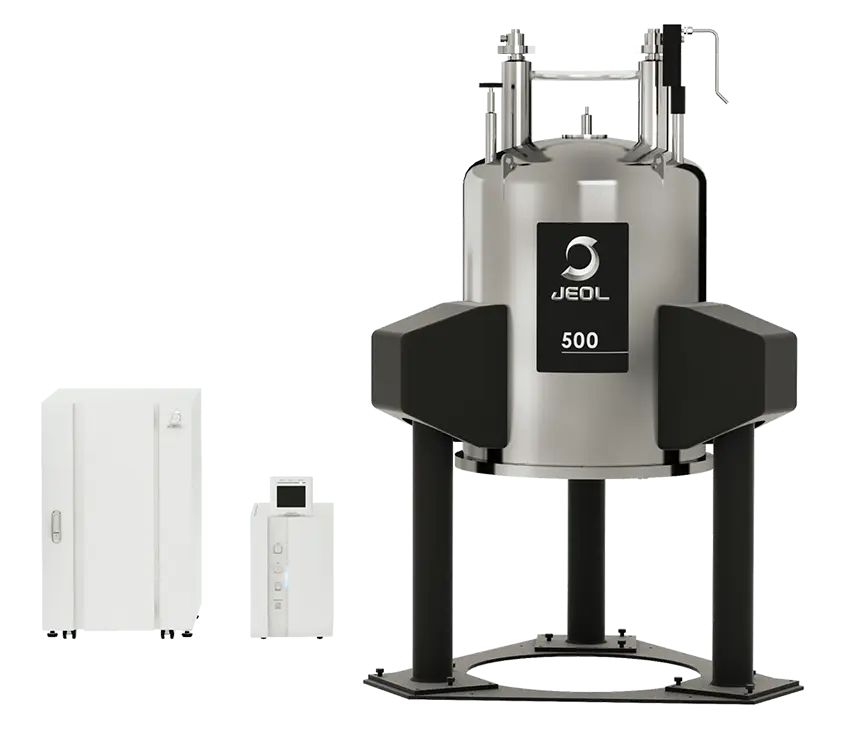
Manufacturer: JEOL — Japan
Overview
The ECZ Luminous (JNM-ECZL series) is an FT NMR spectrometer equipped with state-of-the-art digital and high-frequency technology. Its highly integrated Smart Transceiver System - a high-speed, high-precision digital high-frequency control circuit - enables further miniaturization and high reliability of the spectrometer. The system is capable of high-field and solid-state NMR measurements while maintaining the size of a conventional low-field solution NMR system.
The new Multi Frequency Drive System enables multi-resonance measurements in the standard configuration, providing a wider range of solutions.
Features
STS (Smart Transceiver System)
The ECZ Luminous inherits the STS digital high-integration and high-frequency technology of the previous ECZ series. The sequencer, DDS (Direct Digital Synthesizer), FSU (Frequency Synthesizer Unit), transmitter, receiver, acquisition unit and gate control unit are all integrated on a single RF transmitter/receiver board. Each board carries two 4-frequency source units (one each for HF and LF) and one receiver, so the standard configuration provides a total of eight frequency sources and one receiver. The system can be expanded to four RF transmitter/receiver boards, supporting up to 8 nuclei, 32 frequency sources and four receivers.
The STS transmitter/receiver system is a hybrid of direct-conversion oversampling and superheterodyne undersampling technologies, allowing flexible frequency conversion and efficient, optimal signal transmission and reception depending on the target frequency.
Highly Precise Digital Control
The sequencer provides fast control of frequency, phase and amplitude modulation with a minimum control time resolution of 5 ns. A digital quadrature detection (DQD) circuit enables dynamic frequency and phase modulation, synchronously or asynchronously, in both the transmitter and receiver systems - high-functionality signal processing that is expected to benefit cutting-edge solid-state NMR measurements. A unique streaming transfer technology gives the sequence memory a quasi-infinite capacity, while the same control performance is available for gating and synchronization with external systems.
Where the observed nucleus has a wide chemical shift range, such as 19F, some signals may fall outside the limited bandwidth of conventional rectangular pulses. High-speed phase-modulated pulses excite a much wider range and are very useful in such cases.
Wide Dynamic Range
The receivers are sequencer-controlled and can be independently and dynamically frequency- and phase-modulated for sampling. DQD with 16-bit, 100 Msps high-speed A/D conversion not only improves the effective dynamic range against quantization noise through high-rate oversampling, but also reduces unwanted signals such as intermodulation distortions (IMDs) to the utmost limit. The digital filter is optimized for NMR and ensures quantitative performance over a wide bandwidth.
This high dynamic range lets you clearly capture small signals in spectra that also contain large signals such as solvent - for example, a small 13C satellite signal (about 4.6 millionths) of the acetone signal in a mixed sample of H₂O:DMSO:Acetone = 25131:125:1 (about 10% D2O) is clearly visible.
Low-noise Wideband SiGe Preamplifier
A newly developed low-noise wideband SiGe preamplifier improves sensitivity. In combination with the ROYALPROBE / ROYALPROBE HFX, sensitivity has been improved by about 10%.
Digital Lock Circuit for Stability
The ECZ Luminous uses STS technology to digitally control the 2H lock with high speed and accuracy. The excellent response of the digital feedback circuit suppresses the effects of magnetic field fluctuations more efficiently, enabling stable, long-duration measurements - demonstrated by 12-hour stability test data using 1D 1H-13C HMQC, which must detect 13C-coupled 1H signals (about 1% abundance) while eliminating the 12C-coupled 1H signal (about 99% abundance).
MFDS (Multi Frequency Drive System)
Expanding on the design concept of the HFX system, the newly developed MFDS enables multiple-resonance measurements using triple-resonance probes such as HCN and HCX probes on a standard two-channel spectrometer. Conventional triple-resonance measurements, which require pulse irradiation of three or more nuclides at different frequencies, traditionally demand costly channel expansion and extra installation space. With the multi-sequencer STS architecture and MFDS, the ECZ Luminous performs triple-resonance experiments - such as 13C-31P {1H} correlation (HCP) and CBCACONH (HCN) - on a two-channel spectrometer, opening the door of multiple-resonance experiments to more users.
Easy Shimming
The ECZ Luminous includes a digital matrix shim system (25 shims) for 400 MHz, and a Lagrange shim system (44 shims) for higher-field instruments requiring higher resolution.
Gradient shimming uses magnetic field gradients to measure the field distribution in the sample space, then immediately calculates and applies the appropriate shim values. This allows rapid, automatic shim optimization, even for samples with small volumes or different solvent systems, to obtain spectra with the highest resolution.
Gradient shimming can also be performed on nuclei other than 2H and 1H. For example, for a sample that is only soluble in fluorinated solvents, resolution can be adjusted by gradient shimming on 19F. Accelerated 3D gradient shimming (3 axes) measures a 3D magnetic field map of the sample and applies optimal shim values for the radial terms, making it easy to optimize resolution under various conditions.
Line-up: Three Models
The ECZ Luminous is available in three models to meet a wide variety of user needs. All models feature high-performance digital high-frequency technology and user-friendly Delta software, and the console has been made significantly more compact - the volume of the R series is about 1/3 that of the conventional equivalent.
JNM-ECZL G series
The flagship model, supporting diversified, cutting-edge applications. The spectrometer footprint has been reduced to less than 60% of the ECZR while maintaining expandability: support for three or more channels, high-power amplifiers and high-output magnetic field gradients allows future functional expansion even from a minimum configuration - an adaptable FT-NMR system that can respond as user applications evolve.
JNM-ECZL R series
A compact spectrometer compatible with magnetic fields of up to 600 MHz. The footprint is less than 50% of that of the ECZR, and it can also be used for solid-state measurements.
JNM-ECZL S series
An entry-level model dedicated to 400 MHz solution-state NMR, incorporating the same high-performance digital high-frequency technology as the rest of the ECZL series.
Specifications
| Specifications | JNM-ECZL G series | JNM-ECZL R series | JNM-ECZL S series |
|---|---|---|---|
| Frequency | 400 MHz - 1.3 GHz | 400 MHz - 600 MHz | 400 MHz |
| Sample type | Solution / Solid | Solution / Solid | Solution |
| Number of channels | 2 (standard) | 2 | 2 |
| High frequency power amplifier | 100 W (standard) 200/500/1000 W (as option) | 100 W | 50 W |
| Low frequency power amplifier | 300 W (standard) 500/1000/2000 W (as option) | 300 W | 150 W |
| Magnetic field gradient amplifier | 10 A (standard) 30/50 A (as option) | 10 A | 10 A |
| Console size W×D×H | 600×855×1,279 mm | 536×730×855 mm | 536×730×855 mm |