
JMS-S3000 NewSpiralTOF™
The JMS-S3000 NewSpiralTOF™ achieves a 17-meter effective flight path in a compact design using JEOL's proprietary SpiralTOF ion optics. Mass resolution of 75,000 and 1 ppm mass accuracy serve applications from synthetic polymers and materials science to biomolecules and MALDI mass spectrometry imaging.
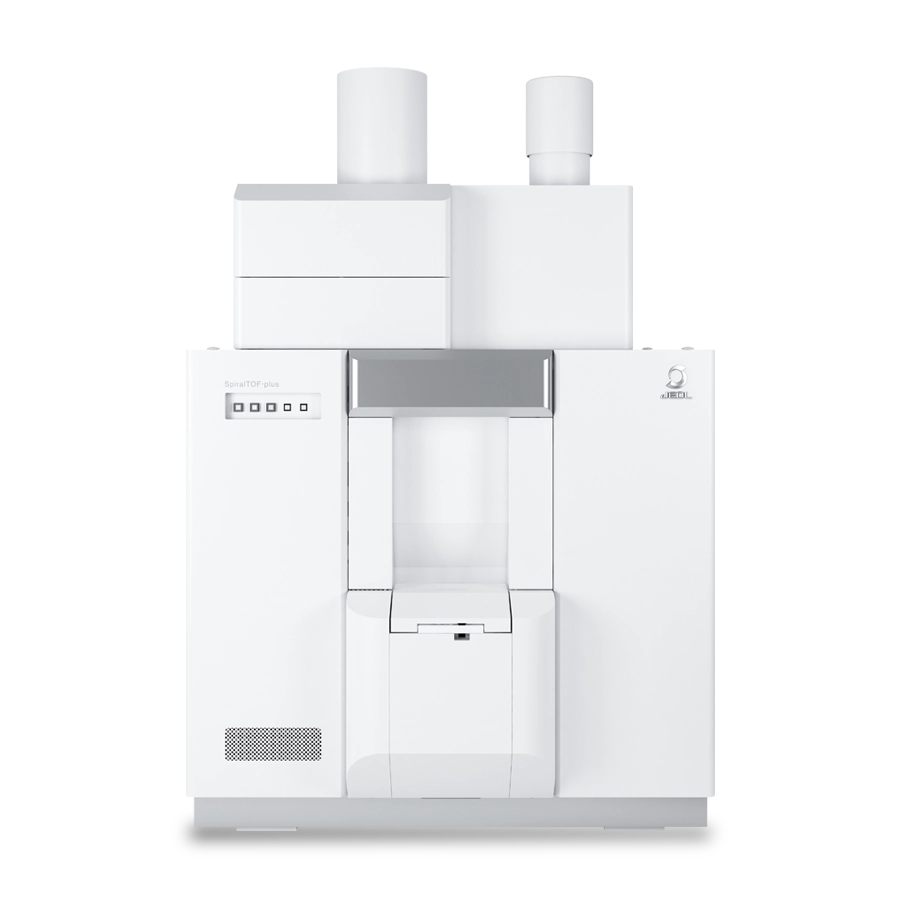
Manufacturer: JEOL — Japan
Overview
The JMS-S3000 NewSpiralTOF™ is a matrix-assisted laser desorption/ionization time-of-flight mass spectrometer (MALDI-TOFMS) built on JEOL's proprietary SpiralTOF ion optics, derived from the MULTUM II ion optics system developed at Osaka University. It achieves an effective flight path of 17 meters in a compact instrument, combining high ion transmission with mass resolution of 75,000 and mass accuracy of 1 ppm using internal calibration. MALDI is far more versatile than commonly assumed — capable of ionizing analytes from very small molecules below m/z 100 to macromolecules exceeding 100,000 — and the NewSpiralTOF™ delivers clean, high-sensitivity measurements across that entire range for research in synthetic polymers, materials science, and biomolecules.
Resolution, Accuracy, and Sensitivity in One Instrument
The 17 m spiral flight path delivers ultra-high mass resolution (75,000) and ultra-high mass accuracy (1 ppm, internal calibration) while preserving sensitivity: ion packets of the same mass are refocused at every cycle of the spiral trajectory and do not diverge from the detection plane. The longer path also improves day-to-day practicality by reducing the influence of specimen-surface irregularities, such as matrix crystal morphology on the target plate or surface variation in imaging specimens, making it easier to obtain high-quality, reproducible data under real-world conditions.
See Small Molecules Clearly with Very Low Chemical Noise
Conventional MALDI reflectron TOFMS systems suffer from chemical noise in the low-mass region caused by post-source decay (PSD) fragments of matrix cluster ions. Because the SpiralTOF ion optics are built from electric sector fields, they act as an energy filter that excludes low-kinetic-energy PSD fragment ions before they reach the detector — leaving a spectrum with virtually no chemical noise in the low-mass region. This was demonstrated by measuring methylephedrine from human urine after a cold medicine dose, detecting the protonated ion with a mass error of just 0.0003 u (1.7 ppm) after only simple desalting.
High-Speed MS Imaging with High Mass-Resolution (Option)
In MALDI mass spectrometry imaging (MALDI-MSI), the specimen surface is coated with matrix, scanned with a laser, and a mass spectrum acquired at each position to visualize where specific molecules are located and how abundant they are. Thanks to the 17 m flight path, the NewSpiralTOF™ delivers high mass resolution even on biological tissue sections with nonuniform surfaces — reaching approximately 40,000 in the average spectrum over a 5 mm × 7 mm mouse-brain region — enough to separate isobaric lipid species such as PC, PE, and GalCer and map each correctly. The optional MS Imaging system adds ITO glass and multi-target plates, the MS Imaging Support Program with imzML export, and the msMicroImager™ viewer.
AI-Enhanced Imaging and Feature Extraction
JEOL adapted its AI-based image enhancement technology LIVE-AI, originally developed for scanning electron microscopy, to MS imaging as the FINE-AI Filter, substantially improving the clarity and interpretability of mass images. With more than 100 lipid species detected in mouse brain sections, vertex component analysis (VCA) models all spectra as mixtures of a small number of vertex components — easier to interpret and faster than principal component analysis — and, applied after FINE-AI denoising, reveals the key components characterizing the tissue. For polymer imaging, msMicroImager™ consolidates hundreds of degree-of-polymerization images into number-average molecular weight, weight-average molecular weight, and polydispersity maps.
TOF-TOF Option
The TOF-TOF option uses SpiralTOF ion optics in the first MS stage for high precursor-ion selectivity and accurate monoisotopic precursor selection. Combined with high-energy collision-induced dissociation (HE-CID), it generates product-ion spectra rich in structural information, and JEOL's proprietary offset parabolic reflectron allows simultaneous acquisition of product-ion information from m/z 5 up to the precursor ion. In one example, reserpine and its photodegradation product — differing by 2 Da — were separated and characterized directly from a mixture, and the option also supports structural analysis of phospholipids and derivatized glycans.
Linear TOF Option
With the Linear TOF option, ions travel directly from the ion source to the detector, so PSD fragment ions and neutral species continue at the same velocity as the precursor and are detected together — making Linear mode particularly effective for high-sensitivity analysis of high-mass compounds prone to PSD. Used alongside Spiral mode, it broadens the range of measurable analytes, confirming the molecular weight distribution of polymers above 100 kDa and measuring immunoglobulin G (IgG), a glycoprotein of approximately 150 kDa.
Life Science and Materials Applications
In life science, the combination of high mass resolution, high mass accuracy, and high sensitivity supports confident protein identification by peptide mass fingerprinting, high-resolution measurement of intact proteins such as ubiquitin, rapid sequence confirmation by in-source decay (ISD) with MASCOT Server, and confirmation of synthetic oligonucleotides. In chemistry and materials, a wide Spiral-mode mass range of m/z 4 to 120,000 enables end-group analysis of polymers above 100 kDa, and accurate mass measurement of covalent supramolecules above 9,000 Da with errors below 0.1 ppm — work paired with the optional msRepeatFinder polymer analysis software.
Stable, Maintenance-Free Contamination-Resistant Ion Source
In conventional MALDI sources, desorbed matrix neutral particles accumulate unevenly on the aperture lens, causing uneven charging and deflection of ion trajectories that degrade sensitivity and resolution and demand frequent cleaning. The NewSpiralTOF™ instead uses a fine, high open-area (greater than 82%) ion extraction grid: less contamination accumulates overall, and the grid's ion-optical properties reduce the impact of any charge that does build up, keeping ion trajectories stable over long-term use for maintenance-free operation with sustained high sensitivity and mass resolution.
Specifications for JMS-S3000 NewSpiralTOF™ MALDI-TOFMS
| Specification | JMS-S3000 NewSpiralTOF™ |
|---|---|
| Instrument Type | MALDI-TOFMS with SpiralTOF ion optics (electric sector spiral trajectory) |
| Mass Resolution | 75,000 (Spiral mode) |
| Mass Accuracy | 1 ppm (Spiral mode, internal calibration) |
| Mass Range | m/z 4 to 120,000 (Spiral mode); m/z 4 to 500,000 (Linear mode) |
| Effective Flight Path | 17 m (Spiral mode); 1.2 m (Linear mode) |
| Spatial Resolution (MS Imaging) | 10 µm (minimum pixel size) |
| Ion Extraction Grid | Fine, high open-area (greater than 82%) grid for contamination-resistant, maintenance-free operation |
| Major Options | TOF-TOF option (HE-CID, offset parabolic reflectron); Linear TOF option; MS Imaging system (ITO glass and multi-target plates, MS Imaging Support Program, msMicroImager™); msRepeatFinder polymer analysis software |
| Software | msTornado™ Control; FINE-AI Filter (AI image enhancement); vertex component analysis (VCA); msMicroImager™; msRepeatFinder (option); MASCOT Server support (option) |
| Power Supply | Mass spectrometer (including rotary pump): single-phase AC 200 V or 220 V to 240 V, 50 Hz, 30 A / AC 200 V to 210 V or 230 V to 240 V, 60 Hz, 30 A; data system: single-phase AC 100 V to 240 V, 50/60 Hz, 15 A; grounding 100 Ω or less |
| Gas Supply | Nitrogen 0.45 ± 0.05 MPa (97% or better purity); helium for CID (TOF-TOF option) 0.45 ± 0.05 MPa (99.999% or better); argon for CID (TOF-TOF option) 0.45 ± 0.05 MPa (99.9% or better) |
| Installation Environment | Floor space 3,200 mm × 2,400 mm; static magnetic field 5×10⁻⁴ T or less; variable magnetic field 1×10⁻⁶ T or less; floor vibration 25 µm (p-p) or less, acceleration 0.1 m/s² or less; room temperature 20 °C to 27 °C (stability ±3 °C/h or better); humidity 30% to 70% (no condensation); maximum heat generation 20,300 kJ/h; ventilation required for rotary pump |
| Dimensions and Weight | MALDI-TOF basic unit: 1,300 mm × 1,000 mm × 1,190 mm, 765 kg (with TOF-TOF option: 1,920 mm height, 874 kg; with Linear TOF option: 1,920 mm, 775 kg; with both: 1,920 mm, 884 kg); rotary pump: 158 mm × 491 mm × 261 mm, 26.3 kg |