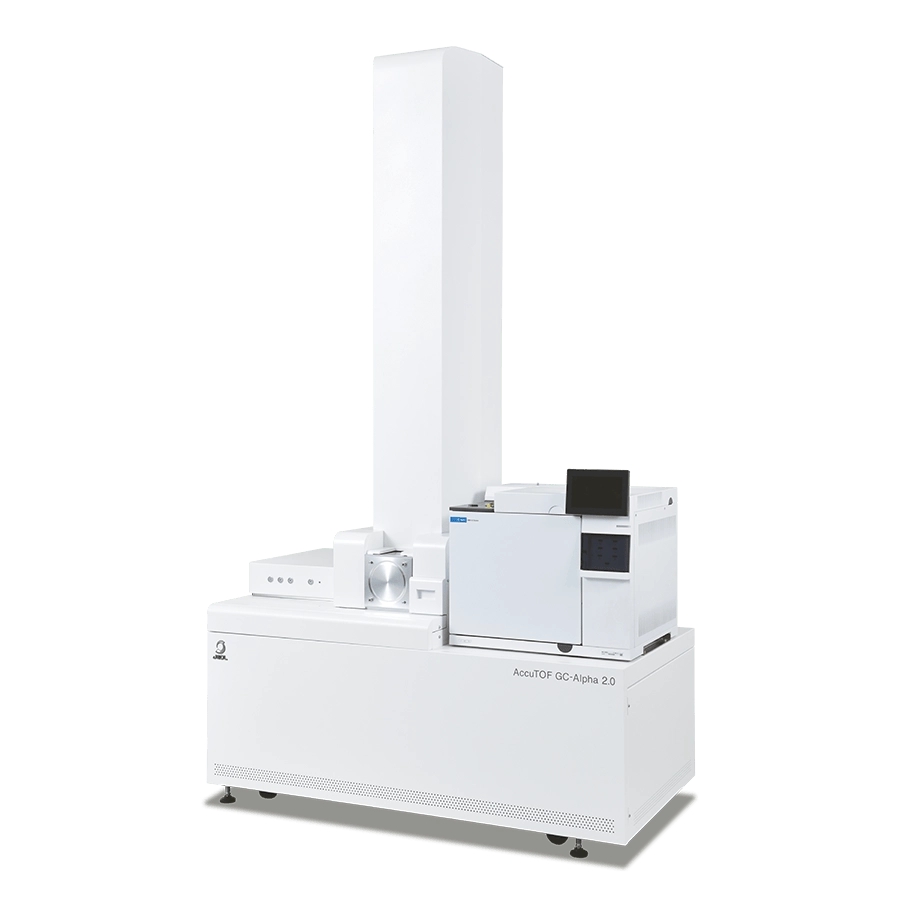
JMS-T2000GC AccuTOF™ GC-Alpha 2.0
The JMS-T2000GC AccuTOF™ GC-Alpha 2.0 is the seventh-generation JEOL GC-TOFMS, combining 30,000 mass resolving power, 1 ppm mass accuracy, and soft ionization with msFineAnalysis AI for automatic structural analysis of unknown compounds — including comprehensive two-dimensional GC×GC data.
Manufacturer: JEOL — Japan
Overview
The JMS-T2000GC AccuTOF™ GC-Alpha 2.0 is the ultimate GC-MS system, pursuing the ultimate in performance and functionality. The seventh-generation JEOL GC-TOFMS has evolved into version 2.0 with the integration of a fully automated standard sample inlet and msFineAnalysis AI, enabling automatic structural analysis of unknown compounds from comprehensive two-dimensional gas chromatography (GC×GC) data — revolutionizing the conventional approach to qualitative analysis using GC-MS. Aiming for high performance while keeping it simple, the system rests on three key technologies: high-performance GC-TOFMS, soft ionization, and AI structural analysis.
High-Performance Time-of-Flight Mass Spectrometer
The AccuTOF™ GC-Alpha 2.0 employs an orthogonal-acceleration time-of-flight mass spectrometer (oaTOFMS) with dual-stage reflectron — an ideal ion optical system realizing both high ion transmission and ultra-high mass resolving power. Four "High" and two "Wide" specifications are achieved simultaneously: mass resolving power of 30,000, mass accuracy of 1 ppm (an average of 0.45 ppm demonstrated on methyl stearate), an instrument detection limit of 18.7 fg (OFN, standard EI source), data acquisition at up to 50 spectra per second for GC×GC and Fast GC, a dynamic range of four orders or more, and a mass range up to m/z 6,000 and higher for direct probe measurements of samples such as oligomers.
Soft Ionization: Essential for Unknown Compound Analysis
EI, using a high ionization energy of 70 eV, generates numerous fragment ions but often fails to show strong molecular ion signals. The AccuTOF™ GC-Alpha 2.0 therefore offers chemical ionization (CI), photoionization (PI), and field ionization (FI) as options — FI being the softest ionization method available for GC-MS and the most suitable for unknown compound analysis. The EI/FI/FD and EI/PI combination ion sources switch between hard and soft ionization with no ion source replacement, no vacuum break, and no reagent gases, and accurate mass measurement is available with every ionization technique.
msFineAnalysis AI: Automatic Structural Analysis
msFineAnalysis AI combines integrated analysis of GC/EI and GC/soft-ionization high-resolution data with AI structure analysis powered by four AI models, automatically performing molecular formula determination, substructure analysis, and structural formula estimation for unknown compounds. Version 3 adds comprehensive two-dimensional gas chromatography (GC×GC) data analysis alongside regular GC-MS analysis — highly effective for complex mixtures such as petroleum and life-science samples — plus target analysis, deconvolution detection, and differential analysis.
Direct MS for High-Boiling and High-Mass Compounds
In direct MS mode, high-boiling-point, high-molecular-weight, and nonvolatile compounds beyond the reach of GC are introduced directly into the ion source — well matched to the instrument's m/z 6,000 mass range. Three probes are available: the DEP (direct exposure probe) for thermally labile compounds, the DIP (direct insertion probe) for solid samples, and the FDP (field desorption probe) for polymers, low- to mid-polar metal complexes, and additives. In one example, FD analysis detected a brominated flame retardant in polypropylene at m/z 943.4797, identified by isotope pattern analysis and composition estimation.
Sample Preparation Options
Sample introduction options extend the application range: a pyrolyzer for thermal extraction and pyrolysis of solids such as polymeric materials, a multi-function autosampler covering liquid injection, headspace (HS), and solid-phase microextraction (SPME), a GC×GC thermal-modulator system delivering dramatically higher separation than conventional capillary GC, and TG-DTA coupling for real-time analysis of evolved gases during thermal analysis.
Specifications for JMS-T2000GC AccuTOF™ GC-Alpha 2.0
| Specification | JMS-T2000GC |
|---|---|
| Ion Source (Standard) | Electron ionization (EI); optional EI/FI/FD combination, EI/PI combination, and CI ion sources |
| Analyzer | Dual-stage reflectron time-of-flight mass spectrometer (orthogonal acceleration) |
| Detector | Dual microchannel plate |
| Data Acquisition System | Continuous averager |
| Mass Resolving Power | 30,000 |
| Mass Accuracy | 1 ppm (based on JEOL's standard for testing) |
| Instrument Detection Limit | 18.7 fg (OFN 100 fg, n=8, standard EI ion source) |
| Spectrum Recording Speed | Up to 50 spectra/s |
| Mass Range | Up to m/z 6,000 and higher |
| Dynamic Range | 4 orders of magnitude or more |
| Gas Chromatograph | Agilent 8890 |
| Data System | Personal computer, monitor, Windows® operating system; msAxel main program; msFineAnalysis AI data analysis program |
| Major Options | EI/FI/FD combination ion source, EI/PI combination ion source, CI ion source, DIP, DEP, FDP direct probes |
| Power Supply | Main console: single-phase AC 190 V to 210 V or 220 V to 240 V, 20 A, 50/60 Hz; gas chromatograph: single-phase AC 200/220/230/240 V, 20 A; data system: AC 100 V to 120 V, 15 A or AC 200 V to 240 V, 7.5 A; grounding 100 Ω or less |
| Gas Supply | Nitrogen 0.5 MPa to 0.6 MPa (97% or better purity); helium 0.5 MPa to 0.68 MPa (99.999% or better purity, hydrocarbon content 0.5 ppm or less) |
| Installation Environment | Varying magnetic field 1×10⁻⁶ T or less; static magnetic field 5×10⁻⁴ T or less; floor vibration 25 µm (p-p) or less; room temperature 20 °C to 27 °C (fluctuation ±3 °C/h or less); humidity 30% to 70% (no condensation); maximum heat generation 25,776 kJ/h; ventilation required for rotary pump exhaust |
| Dimensions and Weight | Mass spectrometer basic unit: 1,430 mm × 790 mm × 2,480 mm, 348 kg; gas chromatograph: 580 mm × 510 mm × 490 mm, 49 kg; rotary pumps (2 required): 120 mm × 288.5 mm × 163 mm, 9 kg each |