
JMS-Q1600GC UltraQuad™ SQ-Zeta
The JMS-Q1600GC UltraQuad™ SQ-Zeta is JEOL's sixth-generation high-end gas chromatograph–quadrupole mass spectrometer. Built on 50 years of MS technology, it pairs the largest hyperbolic quadrupole in its class with best-in-class sensitivity for environmental, water quality, pesticide, material, and odor analysis.
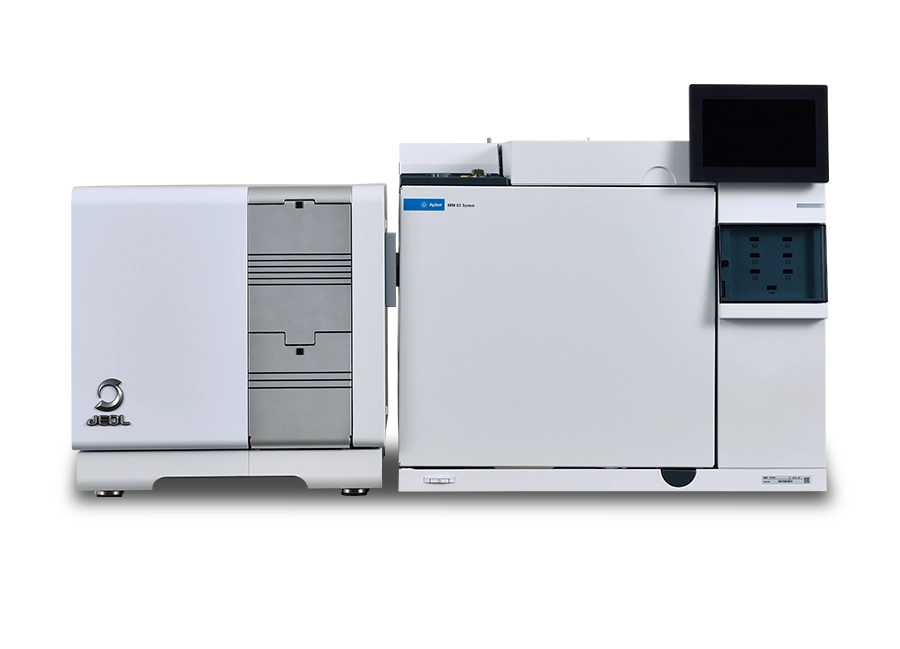
Manufacturer: JEOL — Japan
Overview
The JMS-Q1600GC UltraQuad™ SQ-Zeta is JEOL's sixth-generation high-end gas chromatograph–quadrupole mass spectrometer (GC-QMS), built on 50 years of MS technologies and experience. It is the ultimate high-performance general-purpose GC-MS for a wide range of measurement and analysis needs — from quantitative analysis such as environmental, water quality, and pesticide analysis to qualitative analysis such as material and odor analysis.
Advanced Mass Spectrometry Hardware
The SQ-Zeta is equipped with the largest high-precision hyperbolic metal quadrupole in its class, providing high sensitivity through excellent ion transmission and a wide dynamic range through reduced quench (ion loss) at large ion loads. A pre-filter prevents resolution and sensitivity degradation from quadrupole contamination, the inert titanium ion source chamber needs no parts replacement when alternative carrier gases are used, and a multiplexed draw-in lens ahead of the detector reduces chemical noise and improves sensitivity by ion re-acceleration. A split-flow turbo-molecular pump delivers fast vacuum start-up and supports mega-bore, packed, and the latest low-pressure GC (LPGC) columns, while the ion source block is removed without tools for easy maintenance.
Class-Leading Basic Performance
The standard EI ion source has best-in-class sensitivity: SCAN S/N of 1,000 or more (RMS) for 1 pg of octafluoronaphthalene (OFN) and SIM S/N of 500 or more for 100 fg. The instrument detection limit is 5 fg or less — 2.6 fg achieved in eight consecutive SIM measurements of 20 fg OFN. A dynamic range of more than five orders of magnitude was confirmed from 0.005 pg to 1,000 pg with a coefficient of determination above 0.999, and the analyzer covers a mass range of m/z 1 to 1,022 — measurable from hydrogen.
Alternative Carrier Gases
The SQ-Zeta can be used with helium, nitrogen, or hydrogen carrier gas by simply changing the ion source settings and measurement conditions. Combined with an LPGC column, even chlornitrophene (CNP) — subject to stringent regulatory standards and with low ion sensitivity — delivers results with nitrogen carrier gas comparable to those obtained with helium.
Soft Ionization Methods
Photoionization (PI) and chemical ionization (CI) are available as optional soft ionization methods, and a low-energy EI method is obtained by setting the EI ionization voltage to 10 eV to 20 eV to suppress fragment formation. The EI/PI combination ion source switches between hard and soft ionization simply by turning the filament and VUV lamp on or off — with no source replacement, no vacuum break, and no reagent gases — producing the molecular ion information that database searches alone cannot provide.
Two Unique EI Ion Sources
The optional Enhanced Performance Ion Source (EPIS) achieves an instrument detection limit below 1 fg — 0.6 fg demonstrated with 5 fg OFN — enabling trace-level quantitation, simplified sample concentration, and even replacement of SIM quantitation with SCAN quantitation for non-target analysis. The optional EI ion source for high-concentration samples widens the chamber aperture to reduce contamination, measuring concentrated VOCs in wastewater without dilution with linearity across 0.01 pg to 300 pg. A low-vacuum filament option enables stable measurements such as TG-MS under an oxygen atmosphere.
Comprehensive Software Suite
The MSPRIMO™ control software consolidates tuning, mass calibration, MS and GC methods, and multi-function sequences into one intuitive window. Escrime™, the proven multi-component quantitative analysis software, automatically calculates peak areas and builds calibration curves, while TQ-DioK integrates dedicated dioxin and PCB analysis into Escrime™. The optional msFineAnalysis iQ automatically combines EI library search results with molecular ion information from soft ionization data in a color-coded report, improving identification accuracy over library searches alone.
Specifications for JMS-Q1600GC UltraQuad™ SQ-Zeta
| Specification | JMS-Q1600GC |
|---|---|
| Ion Source | Electron ionization (EI); ionization energy 10 eV to 200 eV; chamber temperature 100 °C to 300 °C |
| Analyzer | High-precision hyperbolic quadrupole mass filter with plug-in pre-filter system |
| Detector | Conversion dynode/ion multiplier detection; positive and negative ion detection |
| Evacuation System | Large differential evacuation system; 1 TMP (ion source 200 L/s or equivalent, analyzer 200 L/s or equivalent); 1 external rotary pump |
| Mass Range | m/z 1 to 1,022 |
| Resolution | 2,000 or better (FWHM, at m/z 614) |
| Scan Speed | 22,222 u/s |
| Measurement Modes | SCAN, SIM, SCAN/SIM |
| Total SIM Channels | 50,000 (100 channels × 500 groups) |
| Sensitivity (EI) | Instrument detection limit (IDL) 5 fg or less (OFN, m/z 272); SCAN S/N 1,000 or more (RMS, 1 pg OFN) |
| Column Oven | Room temperature +4 °C to 450 °C in 0.1 °C steps; ambient influence less than 0.01 °C per 1 °C; heating program up to 20 stages; maximum heating rate 120 °C/min |
| Inlet | Split/splitless; maximum operating temperature 400 °C (extension up to 2 ports possible) |
| Pressure Setting Range | 0 kPa to 680 kPa (for columns of 0.200 mm diameter or more) |
| Total Flow | 0 mL/min to 1,250 mL/min (He) |
| Major Options | Enhanced Performance Ion Source (EPIS, IDL below 1 fg); EI ion source for high-concentration samples; low-vacuum filament; EI/PI combination ion source; CI ion source; DIP/DEP direct probes; GC autosampler; msFineAnalysis iQ; TQ-DioK dioxin software |