
Electron Spin Resonance Spectrometer: JES-X3 Series
The JES-X3 series comprises the JES-X310 and JES-X320 electron spin resonance spectrometers, whose ultra-low-noise Gunn oscillator improves sensitivity by 30% over previous models for direct detection of paramagnetic species across research, inspection, and evaluation.
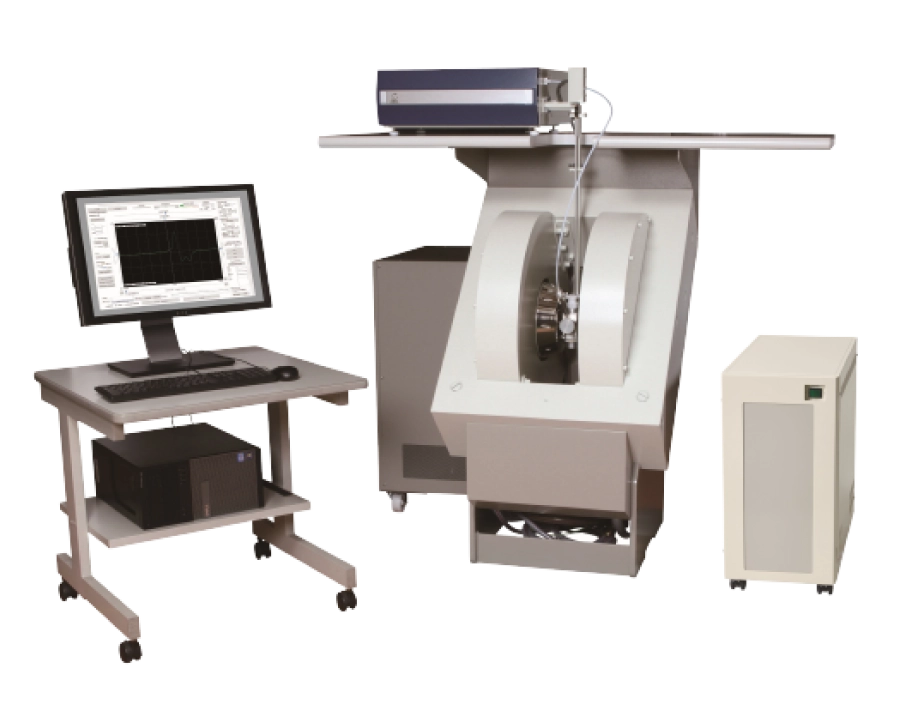
Manufacturer: JEOL — Japan
Overview
Even relatively few unpaired electrons in a sample can affect the function of a material, so ever-lower detection limits are required of ESR measurements. The JES-X3 series — comprising the JES-X310 and JES-X320 — answers with an ultra-low-noise Gunn oscillator that improves sensitivity by 30% over previous models. ESR is the only technique that directly detects paramagnetic species, supporting a wide variety of applications in research, development, inspection, and evaluation. The series adds a built-in microwave frequency counter, an intuitive user interface, various automatic measurement modes, a zero cross-field sweep function, two magnet types to suit the application, and a wide variety of attachments.
High Sensitivity
The standard configuration pairs the Gunn oscillator — a stable, low-noise microwave source — with a cylindrical TE₀₁₁ cavity whose internal modulation method provides modulation with excellent uniformity and a high Q-value (18,000 or more, unloaded). This combination enables high-sensitivity measurements, demonstrated by clear ESR signals from a 1 µM TEMPOL/benzene solution.
High Resolution, Linearity, and Field Stability
High-purity materials are used for the magnet pole pieces and precisely engineered to provide a magnetic field of superior uniformity; ring shims on the pole-piece surfaces extend that uniformity over a wide range, resolving the 4.7 µT t-butyl splitting of the galvinoxyl radical — its smallest division. Field linearity is confirmed by the coincidence of the six Mn²⁺ ESR lines measured while shifting the center field in 20 mT steps, and field stability by the absence of spreading in the finely split perylene cation radical signal even after 100 accumulated scans.
Intuitive User Interface with Automatic Measurement Modes
All functions needed for ESR measurement are presented in one intuitively operated window: start the system, adjust the microwaves from the Q-DIP window, set acquisition conditions, and start measurements. AUTOTUNE automatically optimizes the phase, coupling, and detection of the microwave resonance frequency, with manual tuning, Q-value display, and motor-controlled Mn marker insertion also available. The sequential measurement mode acquires two-dimensional data sets by automatically varying parameters such as temperature, microwave power, modulation width, detection phase, crystal axis, or amplification — in arithmetic, geometric, or user-defined increments — with interval timing, repeat measurement, accumulation, and automatic data saving.
Data Processing and Simulation Software
The standard software extracts the information needed for ESR analysis: g-value tables with Mn-marker field correction, number-of-spins (radical concentration) calculation by double integration against a known standard such as TEMPOL, and peak tables with intensity and linewidth. Waveform processing covers arithmetic operations, differentiation and integration, spectrum separation, background elimination, smoothing, and baseline correction with up to 11th-order regression. Isotropic and anisotropic simulation is included as standard — handling axial as well as rhombic anisotropy — and multiple binary data files can be batch-converted to text or CSV format.
Two Types of High-Performance Magnets
The JES-X310 electromagnet reaches 0.65 T, while the JES-X320 reaches 1.3 T — extendable to 1.7 T with factory-fitted sub pole pieces for Q-band operation. Optional 80 Hz modulation coils enable low-frequency field modulation to avoid rapid-passage conditions.
Attachments for a Wide Variety of ESR Measurements
A rich attachment lineup extends the system: a variable temperature controller (103 K to 473 K, ±0.5 K stability), a liquid helium variable temperature system (2.5 K to 420 K, cool-down in 10 to 15 minutes), aqueous sample cells that minimize dielectric-loss sensitivity reduction, a helix electrode electrolytic cell for polar solvents, a sample angular rotation device with 0.06° resolution, an ultraviolet radiation apparatus with selectable wavelengths, a time-resolved ESR system with a time resolution of several hundred nanoseconds, and a Q-band microwave unit for the JES-X320 that measures sample volumes of only a few µL.
Applications
ESR serves basic research and technology across an exceptional breadth of fields: antioxidant assessment and irradiated food detection in foods, spin trapping of active oxygen in living organisms and pharmaceuticals, dating and dosimetry of fossils and rocks, defect and bonding-state analysis in ceramics and carbon materials, characterization of catalysts, glass, and gemstones, and studies of polymers, batteries, photocatalysts, semiconductors, and organic magnetic materials.
Specifications for JES-X3 Series ESR Spectrometer
| Specification | JES-X310 | JES-X320 |
|---|---|---|
| Maximum Magnetic Field | Up to 0.65 T | Up to 1.3 T |
| Sub-Pole-Piece Magnetic Field | — | Up to 1.7 T |
| Sweep Width | ±0.01 mT to 250 mT | ±0.01 mT to 500 mT |
| Magnetic Field Setting Accuracy | ±5 µT or ±0.1% or less (whichever is larger) | ±5 µT or ±0.1% or less (whichever is larger) |
| Long-Term Stability | 5×10⁻⁶ | 5×10⁻⁶ |
| Pole Diameter (Root) / Effective Gap | 150 mm / 60 mm | 240 mm / 60 mm |
| Microwave Frequency Range | 8.750 GHz to 9.650 GHz | 8.750 GHz to 9.650 GHz |
| Frequency Count Display | 7 digits (standard) | 7 digits (standard) |
| Microwave Output | 0.0001 mW to 100 mW | 0.0001 mW to 100 mW |
| Microwave Tuning | Auto | Auto |
| Cavity Resonance Mode / Q-Value (No Load) | Cylindrical TE₀₁₁ / 18,000 or more | Cylindrical TE₀₁₁ / 18,000 or more |
| Mn Marker | Auto / motor control | Auto / motor control |
| Data System | Windows® 11; 16-bit spectrum resolution; analysis and simulation software standard | Windows® 11; 16-bit spectrum resolution; analysis and simulation software standard |
| Electromagnet Dimensions and Weight (incl. SHF Table) | 1,400 mm × 710 mm × 1,105 mm; 520 kg | 1,400 mm × 803 mm × 1,190 mm; 1,060 kg |
| Spectrometer Dimensions and Weight | 300 mm × 602 mm × 602 mm; 35 kg | 300 mm × 602 mm × 602 mm; 35 kg |
| Excitation Power Supply | Included in magnet chassis | 683 mm × 613 mm × 895 mm; 300 kg |
| Power Requirements | Spectrometer: single-phase 100 V, 500 VA; magnet: 3-phase 200 V, 2 kVA (breaker rating 30 A) | Spectrometer: single-phase 100 V, 500 VA; magnet: 3-phase 200 V, 13 kVA (breaker rating 60 A) |
| Power Supply Fluctuation / Grounding | ±5% / Class D grounding | ±5% / Class D grounding |
| Cooling Water | 0.05 MPa to 0.2 MPa; 6 L/min; 15 °C to 25 °C; faucet outer diameter 12 mm | 0.15 MPa to 0.3 MPa; 8 L/min to 16 L/min; 15 °C to 25 °C; faucet outer diameter 22 mm |