
Microwave Reactor: Monowave 450, Monowave 400, and Monowave 200
Monowave 450, Monowave 400, and Monowave 200 are high-performance microwave reactors specially designed for sequential small-scale microwave synthesis applications in research and development laboratories.
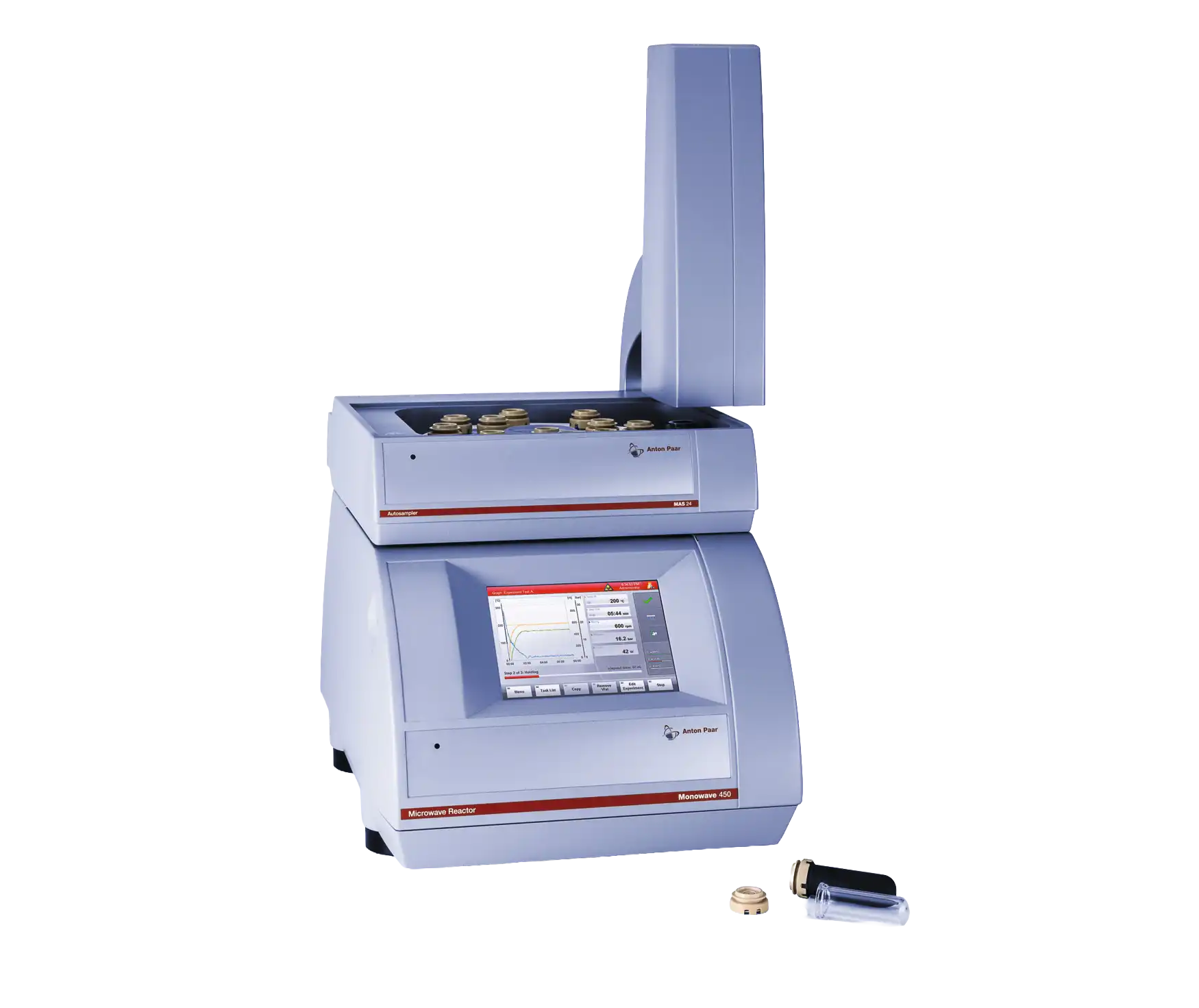
Manufacturer: Anton Paar — Austria
Overview
Monowave 450, Monowave 400, and Monowave 200 are high-performance microwave reactors specially designed for sequential small-scale microwave synthesis applications in research and development laboratories.
Fast and Effective: 24 Sequential Reactions, Unattended
The Autosampler MAS 24 allows 24 unattended reactions, in sequence – saving time, and increasing efficiency. High field density produces fast, uniform heating for all kinds of reactions, up to 300 °C. Powerful stirring of up to 1200 rpm assures temperature homogeneity. The powerful 850 W magnetron adjusts its unpulsed microwave power automatically to the sample. This software-driven self-tuning eliminates any guesswork about sample absorption. Achieve high yields and clean reactions with maximum reproducibility.
The Key Factor in Synthesis: Precise, Scalable Temperature Measurement
Current scientific practice is to use reaction temperature as the relevant parameter in microwave reactions. And accurate measurement of the reaction temperature is the key to correct transferal and scale-up of reaction protocols between different reactors. Monowave reactors measure the temperature via an IR temperature sensor – a robust and reliable method for temperature control ensuring absolutely precise temperature measurement. For accurate control of even more demanding reactions, such as an exothermic reactions, or those involving extremely sensitive samples, simultaneous internal temperature measurement with the optional fiber-optic ruby thermometer is available.
Vials for Heating any Solvent and any Reaction Mixture
In addition to the standard glass vials, silicon carbide (SiC) vessels are available. They absorb microwave energy efficiently, while shielding the interior from microwave radiation – a method that reveals microwave effects caused by selective absorption, and allows comparison between direct microwave heating and conventional heating of reaction mixtures. All parameters, such as the heating and cooling rate, the form factor of the reaction vessel, and the stirring efficiency are identical, apart from the heating mode. All solvents, from non-absorbing ones such as hexane to excellent absorbers such as ionic liquids, can be heated to achieve equal performance – making Monowave the ideal instrument for solvent comparison across chemical reactions. Finally, even chemicals not suitable for glass vials (fluorination agents or alkaline samples) can be processed in the chemically inert, robust SiC vessels.
Save Time, Expenditure, and the Environment with Tool-free and Reusable Consumables
Choose from reaction vials for any scale between 0.5 mL and 20 mL. For bulky samples and extraction applications, a special wide-neck vessel offers convenience without compromising performance. Establish a hassle-free workflow in your laboratory with tool-free handling, and reduce the cost of ownership and the environmental footprint of your research by using reusable vials, septa, and caps.
See Everything: Watch your Synthesis and Analyze it in Real-time
With Monowave 400 and Monowave 450 you can record images and videos with the integrated digital camera. You can follow color changes and precipitation, check the dissolution of substrates, and optimize the stirring efficiency. Monowave 400 R can be combined with Anton Paar’s Cora 5001 Raman spectrometer for in-situ Raman spectroscopy measurements of chemical reactions. Identify intermediates and short-lived transition states, investigate reaction kinetics and optimize reaction conditions with real-time information about the chemical composition of your reaction. The contactless measurement removes any worries about cross-contamination and the need for cleaning in between experiments.
Specifications
| Specification | Monowave 400/450 | Monowave 200 |
|---|---|---|
| Max. Filling Volume | 6 mL for 10 mL vial 20 mL for 30 mL vial 2 mL for 4 mL vial | |
| Max. Operation Pressure | 30 bar (435 psi) | 20 bar (290 psi) (upgradable) |
| Max. IR Temperature | 300 °C | 260 °C (upgradable) |
| Max. Fiber-Optic Temperature | 300 °C | 260 °C (upgradable) |
| Max. Power | 850 W | |
| Vial Material | Borosilicate glass, silicon carbide | |
| Cap Material | PEEK | |
| Camera | Integrated | Optional after upgrade |
| Autosampler MAS 24 | Optional for Monowave 400 Standard for Monowave 450 | Optional after upgrade |
| Seal Material | Teflon-coated silicone | |
| Typical Applications | Method development Optimization Basic academic and industrial research |